
There is a fair amount of nonsense in the ai agent vs chatbot conversation right now. Vendors call everything an "AI agent." Buyers spend agent-tier budgets on what is functionally a chatbot with two API hooks. Engineers build a multi-step agent loop for a problem that a 40-line workflow would solve. This post is the honest version of the comparison, written from the inside of an agency that ships both architectures every month.
The short version is this. An ai agent and a chatbot are not on a continuum of "smart." They are two different architectures, with different cost profiles, different failure modes, and different problems they actually solve. The interesting question is not "which is better." It is "which one does this problem actually need."
TL;DR
- Chatbot = predefined conversation flow, fixed tool calls, deterministic.
- AI agent = LLM reasoning inside a loop, picks tools dynamically, non-deterministic.
- Agents cost roughly 30x to 100x more per conversation in our builds, and run 4 to 15 seconds slower per turn.
- Most "AI agent" products in 2026 are agent-washed chatbots. Gartner's mid-2025 research counted around 130 actually-agentic vendors out of thousands claiming the label.
- Choose the agent only when the path to the outcome cannot be drawn ahead of time. Otherwise a chatbot or a workflow wins on cost, speed, and reliability.
The actual architectural difference
Most ai agent vs chatbot posts get to "agents act, chatbots respond" and stop there. That is true but not useful. The architecture is where the difference matters.
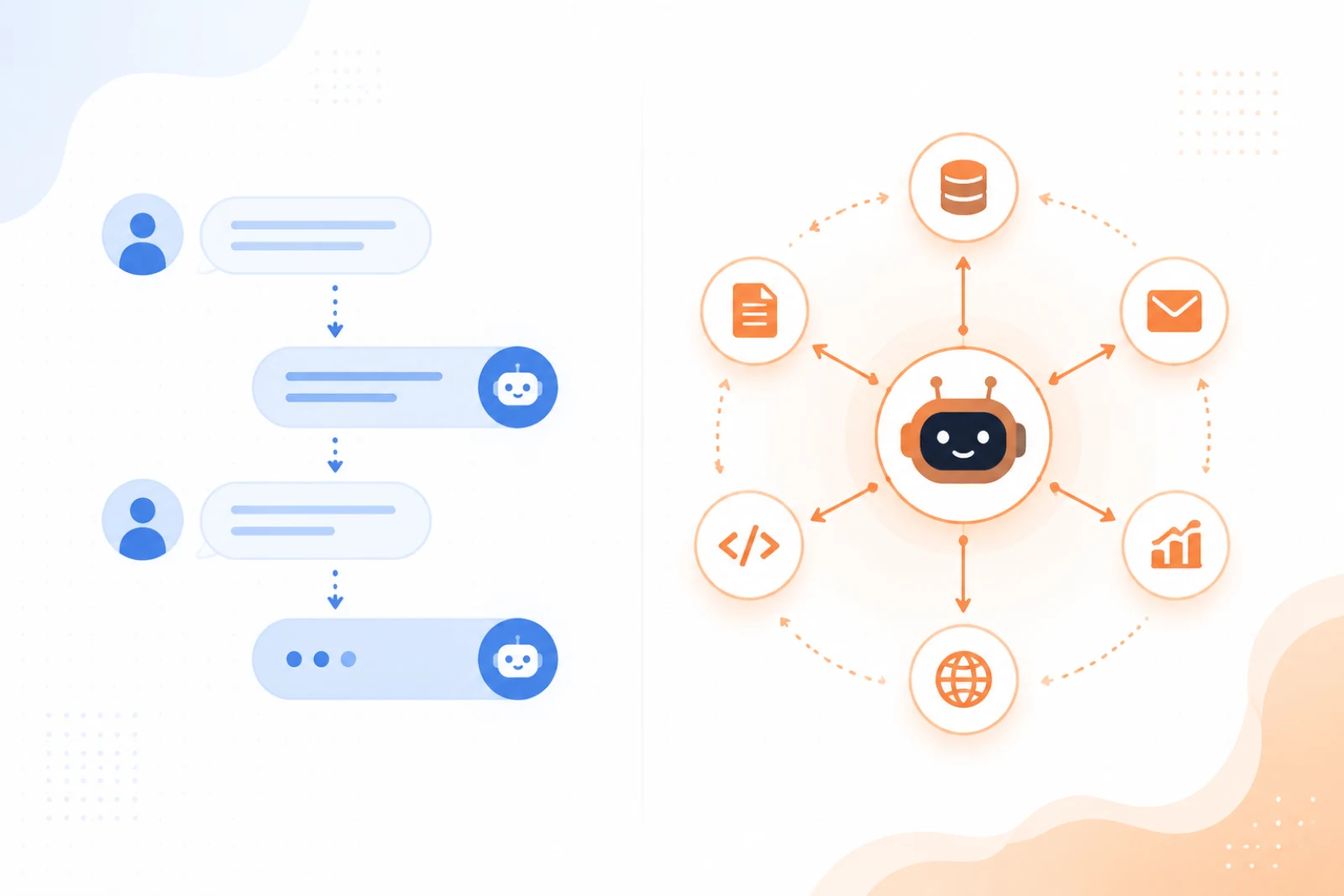
A chatbot is a state graph. At build time, you decide every node, every transition, and every tool call. The LLM (if there is one) generates the response text inside a node, but the path through the graph is fixed. Some nodes call an API, some collect data, some hand off to a human. New conversations follow the same graph the engineer drew.
An ai agent is a loop. At run time, an LLM looks at the current goal and the conversation history, decides which tool to call next (from a list you give it), reads the tool's output, and decides what to do next. There is no graph. There is a goal, a toolset, a stop condition, and the loop. The same agent, given two different requests, may take two completely different paths because the LLM picks them on the fly.
This is the core architectural fork. Everything else - voice, memory, RAG, multimodal inputs - sits on top of one of these two shapes. A voice chatbot is still a state graph wearing a microphone. A voice agent is still an LLM-in-a-loop with speech in and speech out.
If you want to see how this looks at the build level, our pillar on AI automation services walks through the patterns we ship most often, including which shape we pick for which problem.
Why chatbots are not "dumb agents"
There is a common framing that chatbots are just simpler, older versions of agents and everyone will move to agents eventually. That framing is wrong in a way that costs real money.
Chatbots have three properties that agents do not, and those properties are sometimes exactly what you want.
They are deterministic. A chatbot built with a state graph follows the same path every time for the same input. You can test it. You can predict its behavior. You can certify it for regulated use cases. An agent might pick a different tool today than it did yesterday for an effectively identical request, and explaining why is hard.
They are cheap. A chatbot conversation uses an LLM for one or two turns at most, and most of the heavy lifting is hardcoded logic. An agent uses the LLM as the reasoning engine on every loop iteration. In our internal builds (chatbot on Claude Haiku or GPT-4o-mini, agent on Claude Sonnet running 3 to 6 tool calls per task, measured early 2026), the same business task costs roughly 30x to 100x more in tokens when handled by an agent. The gap is shrinking as models get cheaper, but it never closes.
They are fast. A chatbot replies in under a second. An agent that loops through three or six tool calls before responding takes 4 to 15 seconds per turn. For some surfaces (a slack bot, an email triage system) that is fine. For voice or for a customer-facing chat widget, it can be a deal-breaker.
When the conversation is the product - answering FAQs, capturing leads, booking simple meetings, doing first-line support inside a known scope - a chatbot is usually the right tool. The agent shape is overkill, and the overkill shows up in your bill and your latency dashboards.
Where ai agents actually pay off
Agents are not always overkill. There are problems where the chatbot architecture genuinely cannot work, and the agent shape is the right answer.
The pattern that tells you you need an agent is: the right next step depends on what the system finds at the previous step, and the engineer cannot enumerate the branches ahead of time.
Some real examples from our pipeline:
- Inbox triage with action. Read every new email, classify, look up the sender in the CRM, draft a reply if it is a known thread, escalate if not, attach the right invoice if it is a billing question. The right next step depends on the email content and the CRM result, and there are too many combinations to flowchart cleanly.
- Lead research before outbound. Given a name and a domain, find the company size, the industry, the recent news, the relevant decision maker, and write a personalized opener. The path branches at every step.
- Document workflows with judgement. Ingest a contract, find the unusual clauses, compare to a playbook, suggest edits, flag the ones a human must approve. The "unusual" set is open-ended.
- Multi-tool customer support beyond FAQ. Look up an account, check a recent order, decide whether to issue a refund or escalate to billing, write the response, update the ticket. Branches everywhere.
In each of these, the LLM is genuinely doing reasoning, not just generating text. The tools change the world. The loop continues until the goal is met. That is an agent, and the cost is justified because a chatbot literally cannot do the job.
The five-question decision framework
When clients come to us asking "should this be an ai agent vs chatbot," we run them through five questions. The answers decide it most of the time.
1. Can you draw the full conversation as a flowchart in under 30 minutes?
If yes, it is a chatbot. Agents are for problems where the flowchart explodes.
2. Does the system need to do something irreversible (send money, change records, call a customer)?
If yes, lean toward chatbot or workflow with human approval. Agents are non-deterministic and approval gates are easier to enforce in deterministic flows.
3. Is sub-second latency required?
If yes, chatbot or a hybrid where the agent loop runs offline. Real-time agent loops are slow.
4. Will the same input ever need to take a different path tomorrow than it does today?
If yes, that is a signal for an agent. Static paths point at a chatbot.
5. Is the cost per conversation bounded by economics?
If you are running 100,000 conversations a month at $0.20 cost per conversation, that is $20,000 a month in tokens. If the unit economics do not absorb that, you build a chatbot and reserve the agent for the small set of conversations that genuinely need it.
Agent-washing: how to spot a relabeled chatbot
Gartner published research in mid-2025 that became one of the most quoted lines in the industry: out of thousands of vendors marketing themselves as "AI agents," only around 130 were verifiably agentic by any architectural standard. The same research predicted that 40% of agentic AI projects would be canceled by end of 2027, largely because what got bought as an "agent" turned out to be a relabeled chatbot or RPA workflow. The Gartner term for it is "agent washing." Worth taking seriously when you are evaluating a vendor.
Three quick checks tell you if a product is a real ai agent or a relabeled chatbot.
Tool selection at run time. Ask: can the model pick which tool to call based on the conversation, or are tool calls placed at specific nodes in a flow the vendor built? Real agents have a tool registry and the model decides. Chatbots have hardcoded API positions.
Looping with re-evaluation. Ask: after a tool returns a result, can the system decide it needs another tool and call it without going back to the user? Agents loop. Chatbots advance to the next node.
Goal-driven stop condition. Ask: what tells the system it is done? Real agents stop when the goal is met (or a step budget is hit). Chatbots stop when the user closes the window or hits a "thanks, bye" leaf.
If a vendor cannot give you a confident answer on all three, treat the product as a chatbot regardless of the marketing. That is not necessarily bad. A good chatbot is often what you need. But pay chatbot prices for chatbot work.
A grounded comparison
Here is the side-by-side we walk clients through.
| Property | Chatbot | AI Agent |
|---|---|---|
| Path through conversation | Fixed at build time | Chosen at run time |
| Cost per turn | $0.001 to $0.01 | $0.03 to $0.30 |
| Latency | Sub-second | 4 to 15 seconds |
| Reliability | Deterministic | Probabilistic |
| Best for | Bounded, known flows | Open-ended, multi-step goals |
| Failure mode | Dead-end nodes, "I don't understand" | Wrong tool, infinite loop, hallucinated step |
| Debugging | Trace the graph | Read the loop log, hope you can reproduce |
Both architectures are valid. The bad outcome is picking the wrong one for the problem.
A quick note on hybrids (this is what we usually ship)
In practice, the cleanest builds in 2026 are not pure agents or pure chatbots. They are hybrids.
The pattern: a chatbot handles the front door (greeting, intent classification, the 80% of conversations that match a known shape). When the chatbot detects a request that needs reasoning - a complex refund case, an unusual lead, a multi-step research request - it hands off to an agent that runs the loop and returns a result, which the chatbot then delivers.
This gives you the chatbot's cost and latency profile on most conversations and the agent's flexibility on the ones that need it. The architectural seam is the handoff: the chatbot is responsible for deciding when the agent is worth invoking.
A lot of our workflow automation builds sit in exactly this seam. The workflow is deterministic. One of its nodes is an agent call with a budget. The agent does the reasoning step. The workflow takes the structured output and continues.
What this means if you are buying
If you are evaluating ai agent vs chatbot vendors right now, here is the short list of things to do.
- Write the problem down before talking to vendors. What is the actual conversation? What is the desired outcome? Can you draw it as a flowchart? If yes, you do not need an agent.
- Ask vendors the three agent-washing questions above. Their answers tell you what they actually built.
- Get the unit cost. A vendor that cannot quote a cost per conversation is hiding something. Token costs are public. The vendor just adds margin.
- Pilot with real traffic. Both architectures behave differently under real conversation distributions than they do in demo scripts. Two weeks of real traffic teaches you more than four hours of demos.
- Plan the handoff to humans. Whichever architecture you choose, the failure mode is "the system did something wrong." The handoff to a human is the safety net. If the vendor has not designed one, that is the vendor's problem becoming yours.
Where we land
The ai agent vs chatbot framing is useful, but the practical decision is rarely "which one." It is "what shape does this specific problem need, and is it worth the cost overhead to use the more flexible one?"
Most businesses, most of the time, should run chatbots and workflows for the bounded work and reserve agents for the genuinely open-ended jobs. The savings on cost, latency, and debugging time fund a better system overall.
If you want a second opinion on a specific build - whether your problem actually needs an agent, or whether a chatbot-plus-workflow would ship faster and run cheaper - that is the conversation we have on a discovery call. You can grab a slot via the AI automation services page, or look at how we package this work for partner agencies on the white-label automation track.
Pick the architecture the problem actually needs. The marketing will catch up.