For agencies that want to resell CRM services to SMB clients, GoHighLevel wins. White-label, unlimited sub-accounts, native voice and SMS, and an all-in-one stack at a flat price make it the clear pick. For in-house B2B sales and marketing teams that need deep reporting, a large marketplace, and mature team collaboration tools, HubSpot wins. The choice comes down to who is buying. Agencies pick GHL. Product companies pick HubSpot. Everything else in this comparison flows from that.
Quick comparison
| Factor | GoHighLevel | HubSpot |
|---|---|---|
| Pricing | $97 to $497/month flat, unlimited users | Free CRM, paid hubs $20/seat to enterprise |
| Target user | Agencies, SMB service businesses | B2B companies, sales and marketing teams |
| Native AI | Conversation AI, Voice AI, workflow AI | Breeze AI (copilot, agents, intelligence) |
| White-label | Full white-label on Pro plan | Partner program, limited branding control |
| Marketplace | Growing but smaller, agency-focused | Largest app marketplace in CRM |
| Learning curve | Steep but rewarding, agency-centric | Moderate, strong documentation |
| Voice and SMS | Native, A2P ready | SMS via add-on, calling in Sales Hub |
| Best for | Agencies, dental, real estate, service | B2B SaaS, mid-market, RevOps teams |
What is GoHighLevel?
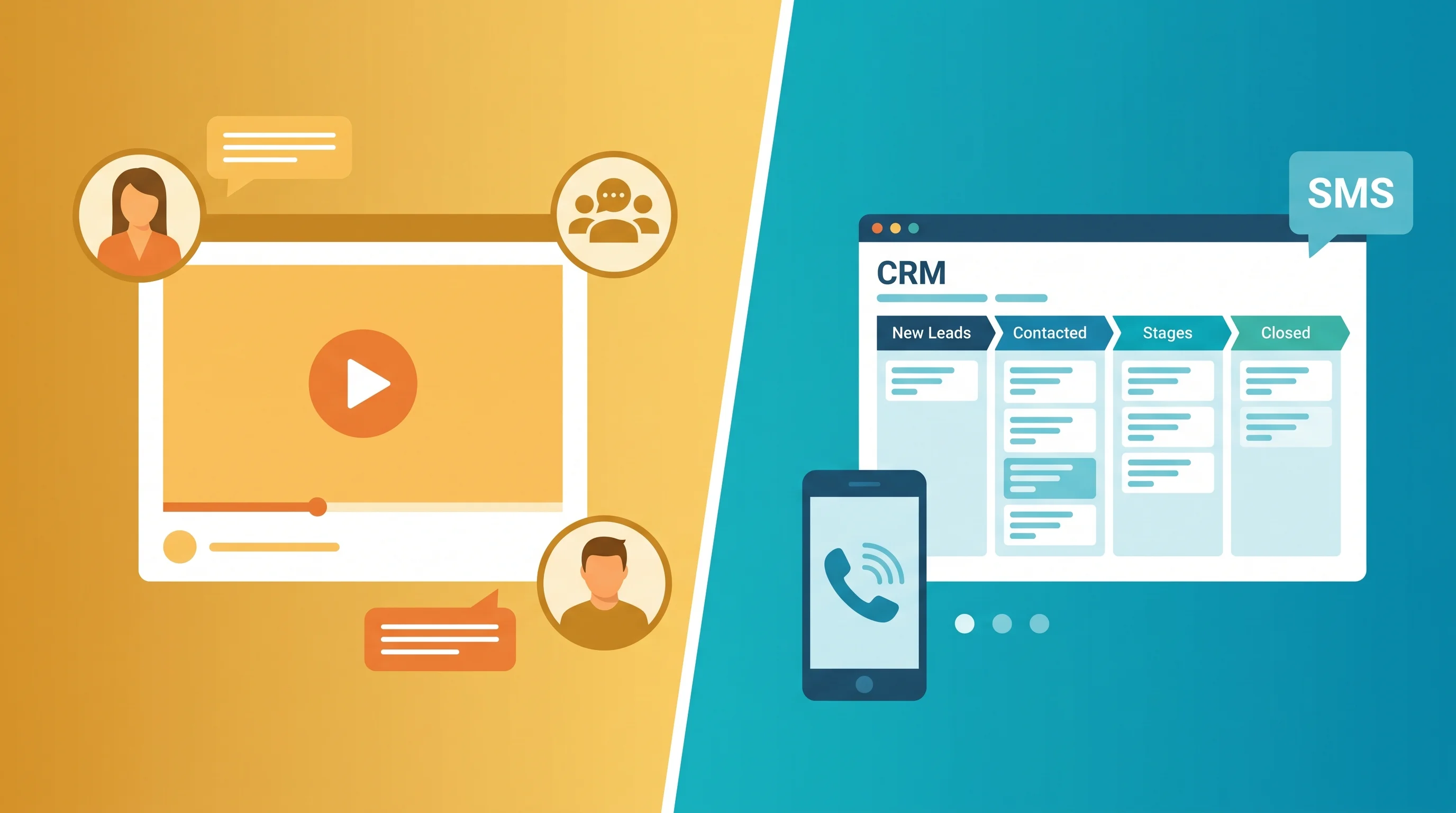
GoHighLevel (GHL) is an all-in-one sales and marketing platform built primarily for agencies. In one stack you get CRM, pipeline management, email marketing, SMS, calling, calendar booking, landing pages, funnels, memberships, surveys, reputation management, and automation workflows. The bet GHL made is that SMB clients do not want six tools, they want one, and agencies do not want to manage six contracts, they want one white-labeled platform they can resell.
GHL accounts have sub-accounts, so one agency can run 50 client accounts from a single dashboard. The Pro plan adds SaaS mode which lets you sell the platform itself to clients under your own branding at your own price. This is why GHL has become the #1 CRM for automation agencies, and why we see it in roughly one in five Upwork jobs we look at. Our GoHighLevel service is built around this reality.
What is HubSpot?
HubSpot started as inbound marketing software and has grown into a full CRM platform with specialised hubs for Sales, Marketing, Service, Content, Operations, and Commerce. HubSpot's free CRM is genuinely useful and hundreds of thousands of companies run on it. The paid hubs add automation, reporting, and collaboration depth that a serious B2B sales and marketing operation needs.
HubSpot's strength is the mature product experience and the enormous marketplace of integrations, templates, and agency partners. If you are a 50-person B2B SaaS company with a marketing team, an SDR team, and a customer success team, HubSpot gives each group the tools they need and stitches them together with shared contact records.
How does pricing compare?
GoHighLevel has three main tiers: Starter at $97 per month, Unlimited at $297 per month, and Pro (also called SaaS) at $497 per month. Starter supports up to 3 sub-accounts, Unlimited supports unlimited sub-accounts, Pro adds SaaS mode with rebilling. All tiers include unlimited users and unlimited contacts. You pay additional usage fees for SMS, email, and calling at cost-plus rates, or pay Twilio and Mailgun directly.
HubSpot pricing is more complex. The free CRM is truly free. Starter tier for Sales Hub or Marketing Hub starts around $20 per seat per month. Professional jumps to around $800 to $900 per month and adds automation, A/B testing, and reporting. Enterprise tier runs into the thousands per month. On top of seat pricing, Marketing Hub is priced by marketing contacts so costs scale with your list size.
For an agency running 20 SMB clients, GoHighLevel Pro at $497 per month replaces 20 separate HubSpot subscriptions that would cost $15,000 or more per month combined. That math is why agencies move to GHL. For a single 30-person B2B company with 100,000 contacts, HubSpot Professional is worth the spend because of what you get inside the product.
White-label and resell economics
This is where GoHighLevel has no real competitor. On the Pro plan, you put the platform on your own domain, replace the logo, set your own pricing, and charge clients whatever you want. Your cost is $497 per month. If you charge 10 clients $297 per month each, you gross $2,970 per month on a $497 cost. This is the productized SaaS model that has created thousands of six and seven figure GHL agencies.
HubSpot has a Solutions Partner program with commissions and co-marketing, but you are selling HubSpot, not your own brand. Clients sign up with HubSpot, pay HubSpot, and can leave you for another partner while keeping the product. The economics are different. HubSpot partners make money on services and implementation. GHL agencies make money on recurring software margin.
If recurring subscription revenue with agency margin is the goal, GHL is the pick. If you want to be part of the largest CRM partner ecosystem and sell consulting services, HubSpot is the pick.
Native AI capabilities
HubSpot launched Breeze as its unified AI layer in 2024 and has expanded it through 2026. Breeze Copilot sits inside the product and helps with writing, prospecting, and summarising records. Breeze Agents run background tasks like prospecting research and content creation. Breeze Intelligence pulls in enriched company and contact data. The experience is polished and works well inside HubSpot's existing workflows.
GoHighLevel ships Conversation AI for inbound chat and SMS, Voice AI that plugs into the phone system, and workflow-level AI actions (summarise, classify, generate). GHL's AI is less polished than HubSpot's but more practical for SMB automation use cases because it is directly wired into calls, texts, and workflows. For most service businesses, the GHL AI stack does exactly what they need. For a B2B team doing research-heavy prospecting, Breeze is ahead.
Either way, if you want a voice agent that books appointments in your CRM, you are pairing a dedicated voice AI platform with either CRM. We cover this in our voice AI service.
Native voice and SMS
GoHighLevel was built around calls and SMS from day one. You provision a Twilio number (or bring your own), handle A2P 10DLC registration from inside the platform, and trigger SMS and outbound calls from workflows. The voice agent integrations plug into GHL calendars and contacts cleanly. For any business that lives on phone calls and texts (real estate, dental, gyms, local services), this native stack is a big deal.
HubSpot has calling inside Sales Hub with recording, transcripts, and Breeze summaries. SMS is available through third-party integrations or the HubSpot SMS add-on. It works, but it is not the product's center of gravity. For a B2B team running email-first outbound, this is fine. For a dental office running a voice AI receptionist, GHL is a much better base.
Marketing automation depth
HubSpot has the deeper marketing automation product. Lead scoring, complex branching workflows, multi-channel campaigns, attribution reporting, A/B testing on emails and pages, and the reporting to tie it all together. For B2B marketing operations teams, HubSpot is built for this and delivers.
GoHighLevel has more than enough automation for SMB use cases. Visual workflow builder, triggers on every event, branching, waits, and actions across email, SMS, calls, and booking. It is not as polished for complex multi-touch B2B campaigns, but for a local business sending appointment reminders, follow-ups, and review requests, it is plenty.
Reporting and analytics
HubSpot wins on reporting. Custom reports, attribution models, dashboards, funnel analysis, and deal velocity reporting all ship in the product and get better at Professional and Enterprise tiers. For a RevOps team that needs to tie marketing spend to pipeline to closed revenue, HubSpot is the better platform.
GoHighLevel reporting has improved but remains simpler. You get pipeline views, appointment reports, campaign stats, and attribution for calls and SMS. For agency reporting to SMB clients, this is enough. For deep B2B revenue analytics, it is not.
Which is best for you
Agencies selling CRM, marketing, and automation to SMB clients. Pick GoHighLevel. White-label, unlimited sub-accounts, native voice and SMS, and the SaaS mode pricing make this the right base.
B2B SaaS companies scaling sales and marketing in-house. Pick HubSpot. Seat-based pricing, deeper marketing automation, and reporting depth are worth the spend.
Ecommerce brands running post-purchase flows and customer support. Pick HubSpot if you already run Shopify and want Content Hub plus Marketing Hub. Pick GHL if you are a smaller brand that wants one stack for everything.
Scaling SMB moving from spreadsheets to a real CRM. Pick GoHighLevel if your business runs on phone calls, SMS, and bookings. Pick HubSpot if your business runs on email, demos, and long sales cycles.
Local service businesses (dental, real estate, gyms, home services). Pick GoHighLevel. The native calling, SMS, review management, and calendar booking match exactly what these businesses need.
Final verdict
GoHighLevel and HubSpot both do CRM, but they are built for different buyers. GoHighLevel is the agency and SMB service business platform: one price, unlimited users, white-label resell, and voice and SMS built in. HubSpot is the in-house B2B platform: per-seat pricing, deep reporting, a mature marketplace, and polished AI.
Most confusion comes from comparing them as if they were interchangeable. They are not. If you are starting or scaling an agency, GoHighLevel is the right bet. If you are a B2B company building out internal RevOps, HubSpot is the right bet. If you want help deciding or setting up either platform, get in touch and we can walk through your specific use case.