
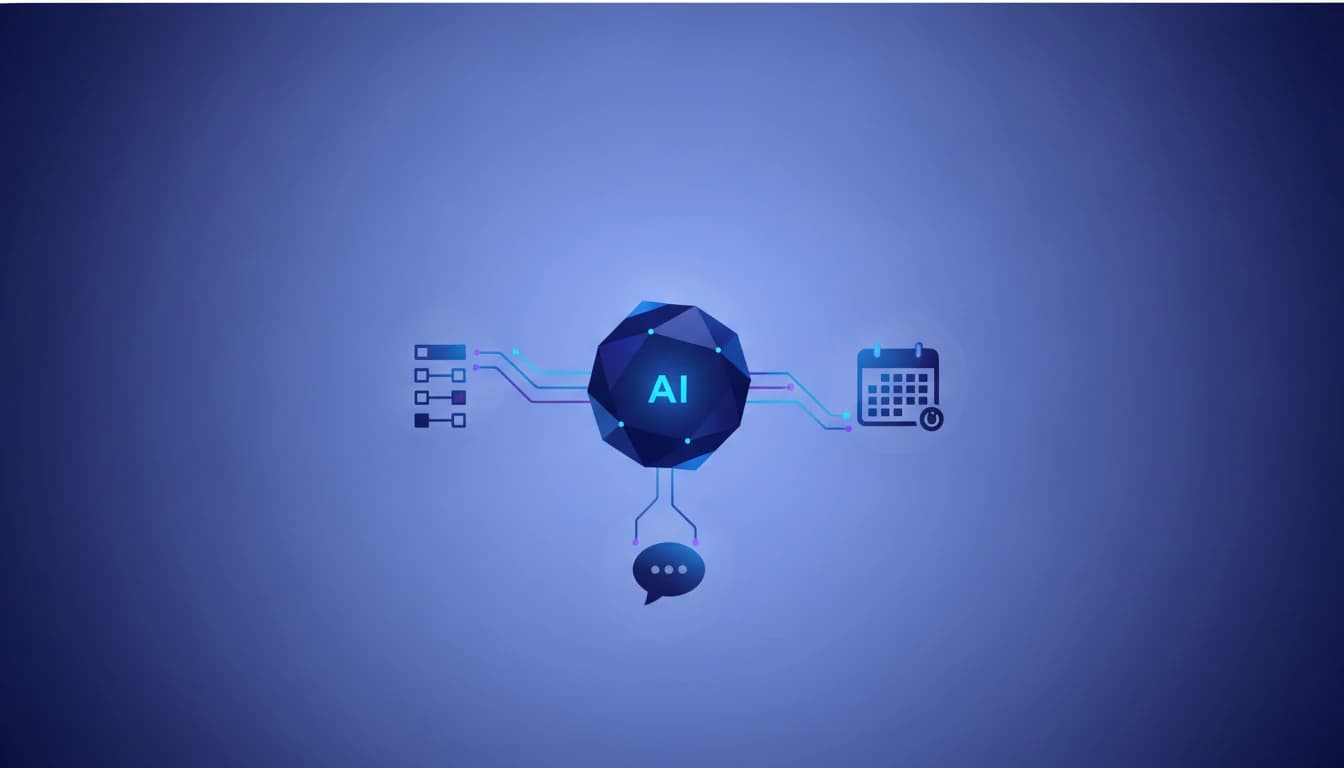
What is an AI sales agent, and will one actually close deals for a business like yours?
Short answer: an AI sales agent is software that can qualify leads, follow up, book meetings, and update your CRM with little or no human input - and whether it closes anything depends far less on the tool you pick than on what it is plugged into.
That second half is the part almost nobody tells you. Search "ai sales agent" and you get ten lists of ten tools, most written by one of the ten tools, comparing feature grids and pricing tables. They answer "which product" and skip the question that decides whether this works: what does the agent need to be wired into before it can move a single deal?
This guide is about that. If you would rather skip the theory and have an agent built into your CRM, calendar, and channels from day one, that is what our AI automation service is for.
What an AI sales agent actually is
An AI sales agent combines a large language model with automation so it can take actions, not just talk. Salesforce's guide to AI sales agents splits them into two useful buckets:
- Autonomous agents that act on their own from your data and workflows - for example, an SDR agent that engages an inbound lead by email or chat, answers questions, and books the meeting.
- Assistive agents that work alongside a human - for example, a coach that roleplays calls or drafts the next follow-up for a rep to approve.
The difference between an agent and a chatbot is the ability to do things. A chatbot answers "what are your hours." An agent reads the lead, checks your calendar, books the slot, logs the activity, and notifies the rep. If you want the deeper distinction, we broke it down in AI agent vs chatbot.
IBM's overview of AI agents in sales lists the common jobs: outreach at scale, lead qualification and nurturing, meeting prep, next-best-action suggestions, quoting, and data entry. Notice how many of those require the agent to read from and write to your other systems. That is the whole point of this article.
Why most AI sales agents send email but never close
Here is the failure pattern we see constantly. A team buys a well-reviewed AI sales agent, connects it to an inbox, and points it at a lead list. Two weeks later the verdict is "it sends nice emails but nothing happened."
Nothing happened because sending email is the easy 10 percent. Deals move when the agent can:
- Read the pipeline. Which leads are new, which are stalled, which already talked to a human. Without CRM access the agent treats a closed-won customer and a cold lead identically.
- Book into a real calendar. Not "let me suggest some times" - actually place the meeting and send the invite, so a warm lead never cools waiting for a reply.
- Write activity back. Every touch logged to the contact record, so your closer opens the deal and sees the full history instead of starting blind.
- Hand off cleanly. Know when a lead is qualified and route it, with context, to the right person or the next automation.
An agent that only has an inbox can do exactly one of those things. That is why the model you choose matters less than the plumbing behind it. The best language model in the world cannot advance a deal it cannot see.
Buy, build, or integrate: the real choice
The listicles frame this as a shopping decision. It is really an architecture decision with three options.
Buy off-the-shelf. Fastest to start. Great when your process is standard and your CRM is one the tool natively supports. The risk is that "native support" often means a shallow sync, and your actual sales motion has quirks the tool cannot model. Published prices vary widely by vendor - HubSpot, for instance, bundles its AI features into paid Sales Hub seats rather than selling them standalone (see HubSpot's pricing page) - and integration plus maintenance often cost as much as the subscription itself. Treat any sticker price as a floor, not the total.
Build from scratch. Maximum control, maximum cost and time. Rarely the right first move for a small or mid-sized team - you end up maintaining infrastructure instead of selling.
Integrate. Take a capable agent framework and wire it into the systems you already run - your CRM, calendar, phone, and email - so it fits your motion instead of forcing your motion to fit a product. This is the middle path most growing teams actually want, and it is where an AI automation partner earns its fee: the value is in the connections, not the chatbot.
If your sales motion runs on GoHighLevel, that integration work is a specific discipline - our GoHighLevel automation service handles the pipeline, calendar, and follow-up wiring so the agent operates inside the CRM your team already lives in.
Where AI sales agents pay back fastest
Not every sales task is worth automating first. The clearest early wins share one trait: speed changes the outcome.
- Lead response. The lead who gets a reply in one minute versus one hour is a different conversion rate entirely. An always-on agent that responds instantly is often the single highest-ROI use case.
- Follow-up. Most deals die from silence, not rejection. An agent that runs a persistent, personalized follow-up sequence recovers revenue your team was already losing.
- Qualification and routing. Let the agent ask the qualifying questions and route only real opportunities to human closers, so expensive people spend time on deals that can close.
For voice-heavy motions - inbound calls, appointment setting, outbound qualification - the agent lives on the phone, not in an inbox. That is a different build with its own tradeoffs, covered in our voice AI service and our Retell vs Vapi vs Bland comparison.
A quick, honest ROI frame
Do not trust a vendor's ROI slide. Do your own, and keep it illustrative until you have real numbers.
As an illustration only: say you get 200 inbound leads a month and currently reach 60 percent in time. If an instant-response agent lifts that to 90 percent, that is 60 more leads engaged monthly. At a 20 percent close rate and a 1,000 dollar average deal, that is 12 extra deals - example math, your inputs will differ, but it shows why speed-to-lead, not the tool's logo, is the number to model first.
The point of the exercise is discipline: pick one metric the agent should move, measure it before and after, and ignore feature counts.
How to evaluate a tool or a partner
Whether you are demoing a product or hiring someone to build one, the same questions cut through the pitch:
- Show me it booking a real meeting into a real calendar, end to end, not a canned demo.
- Name my exact CRM and show the fields it reads and writes. Vague "integrations available" is a red flag.
- What happens on a weird lead - a duplicate, an existing customer, an angry reply? Watch how it degrades.
- Who owns it in month three when your process changes? The tool that shipped and vanished is the tool that stops matching reality.
For a broader shortlist of platforms to run these tests against, see our roundup of the best AI automation tools. Pick a couple, then judge them on the four questions above rather than the feature grid.
The decision rule
Buy or build an AI sales agent only when you can name the CRM, calendar, and channel it will connect to, and the one metric it must move. If you cannot answer both, you are not ready to pick a tool - you are ready to map your sales motion first, because an agent wired into nothing closes nothing.
Everything else - the model, the brand, the pricing tier - is secondary to that plumbing. Get the connections right and a modest agent outperforms a brilliant one bolted onto an empty inbox.
If you would rather have that plumbing designed and built correctly the first time, talk to our AI automation team. We map your pipeline, wire the agent into the systems where your deals actually move, and hand you something that books, logs, and routes - not just something that sends email.