
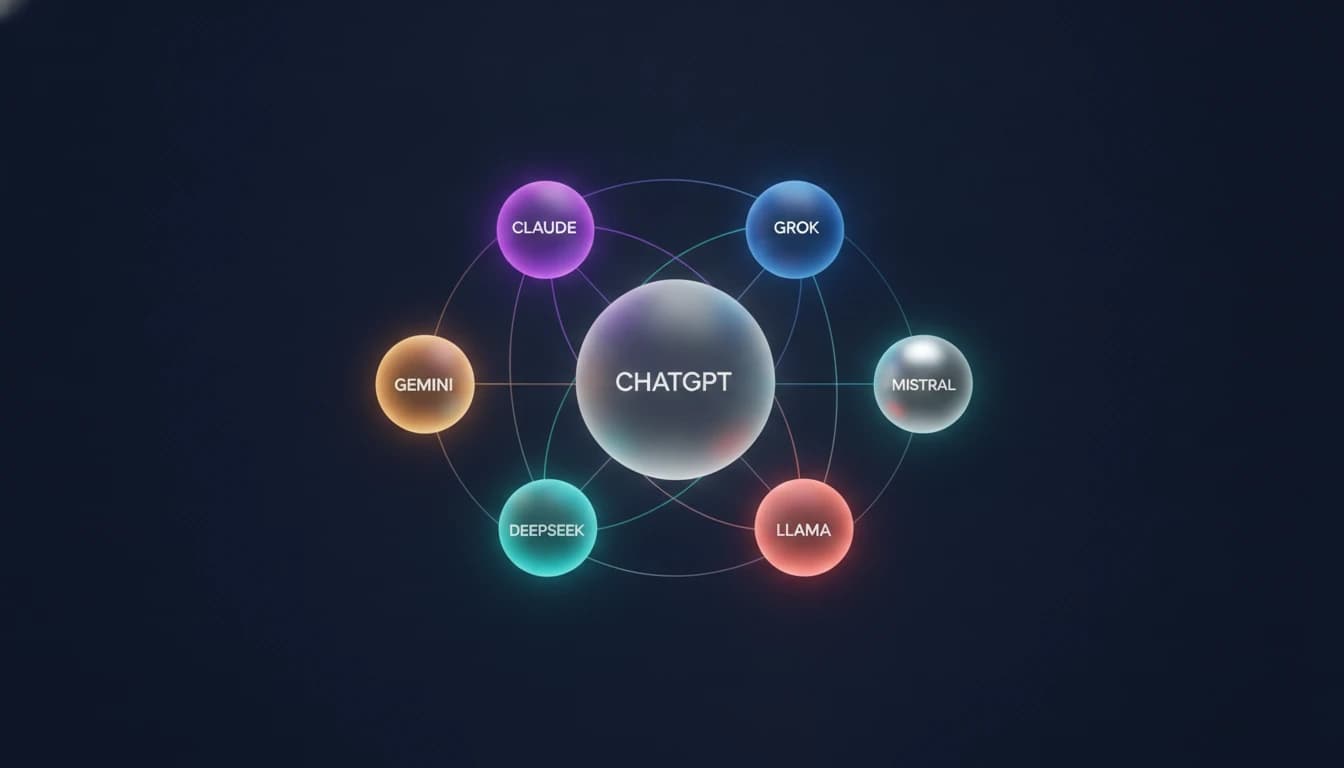
We ship AI systems for clients every week. Almost none of them run on ChatGPT.
Not because ChatGPT is bad. It is fine. The issue is that "ChatGPT" is a consumer brand and the workloads agencies actually ship have different shapes: long agentic loops, tool use under load, sub-second voice latency, structured output that does not drift, hosting under client compliance rules. The model that wins for those jobs is rarely the default OpenAI pick.
This is the honest tour of the ChatGPT alternatives we actually use in production, what each one is good at, and when we still reach for GPT.
TL;DR
- Claude Opus 4.7 is our default for agentic work: coding agents, multi-step tool use, anything that has to think for more than one turn.
- Claude Sonnet 4.6 is the cost-quality sweet spot for high-volume client workloads.
- Gemini 2.5 Pro wins when context is genuinely huge or the inputs are multimodal.
- Grok 4 is the surprise pick for big context at low cost.
- DeepSeek V3 is the cheapest near-frontier model and it is not close.
- Llama 4 and Qwen 3 are what we self-host when the client cannot send data to a third party.
- Mistral Le Chat is the EU-sovereign default.
- Perplexity Sonar is the drop-in "search and cite" node.
- ChatGPT alternatives are not a single product category. They are a toolbox. Treat them that way.
Why we stopped defaulting to ChatGPT for client work
A consumer asking ChatGPT to write a poem does not care which model answered. A client paying us to build an AI receptionist or a data extraction pipeline does care, even if they do not know it yet.
Here is what changed our defaults.
Agentic behavior. When we wire a model into a 15-step tool-use loop, the failure mode matters. Claude Opus 4.7 finishes those loops cleanly. GPT-5 finishes most of them. The gap is small per turn and large per workflow.
Cost at volume. A client running 50 million tokens per month through GPT-5 pays a meaningful four-figure bill. The same workload on DeepSeek or Gemini Flash drops one order of magnitude. When the model is doing routine extraction or classification, that gap is pure margin.
Context recall. Pages 1 to 50 of a 200K-token context perform well across all frontier models. Pages 150 to 200 are where Claude and Gemini meaningfully outperform. If you summarize long documents or audit logs, the back of the context window is where you live.
Vendor lock-in. One provider outage takes down every client that depends on you. Multi-provider routing using something like LiteLLM is now table stakes for production work, which is covered in our AI automation services playbook.
If you are running ChatGPT for personal productivity, keep using it. If you are building systems that other people depend on, the alternatives below earn their keep.
The shortlist: 12 ChatGPT alternatives we actually use
1. Claude Opus 4.7 (Anthropic)
The model we reach for first on hard agentic work. Coding agents, multi-tool reasoning, long-context audits, anything where the model has to plan and revise. The 1M context window means we can throw entire client codebases at it without slicing. Pricing is at the top of the market and worth it for high-stakes tasks.
2. Claude Sonnet 4.6 (Anthropic)
The workhorse. Roughly 80% of Opus quality at a fraction of the cost. We use Sonnet for the bulk of client production: support agents, content generation, document processing, voice agent orchestration. Sonnet is the model most of our shipped systems run on.
3. Gemini 2.5 Pro (Google)
Wins on three things: true 1M-plus context with strong recall, native multimodal input including video and audio, and the deepest integration into Google Cloud. If a client has data in BigQuery and Drive, Gemini reads it natively without a custom data layer. Our data analytics work leans on Gemini for this reason.
4. Gemini 2.5 Flash (Google)
The cheapest frontier-tier latency option. Sub-second response on most workloads, multimodal in, structured output out. We use Flash for high-volume classification and any pipeline where the model is one step in a larger flow.
5. Grok 4 (xAI)
The dark horse. Aggressive pricing at very large context windows and surprisingly competent at agentic work. Best-in-class for analyses that need to incorporate fresh data from X. Less reliable than Claude or Gemini for production-critical tasks but the cost story is hard to ignore.
6. DeepSeek V3 / R1 (DeepSeek)
The cheapest near-frontier model on the market by a wide margin. We use DeepSeek for batch jobs and any high-volume routine work where quality at the 95th percentile matters more than at the 99th. Open weights also mean we can self-host for clients who cannot use a Chinese API.
7. Llama 4 (Meta)
Our go-to open-weight model for self-hosted deployments. We run it on cloud GPUs or on-prem when a client has compliance requirements that rule out hosted APIs. Quality is one tier below hosted Claude and Gemini but more than adequate for most production tasks. Crucial for healthcare, legal, and finance clients where HIPAA, attorney-client privilege, or data residency rules make sending prompts to a third party a non-starter.
8. Qwen 3 (Alibaba)
The other open-weight model worth knowing. Strongest open-weight option for multilingual workloads and structured output. We use Qwen when a client serves non-English markets at scale and self-hosting is on the table.
9. Mistral Le Chat + Mistral Large 2 (Mistral AI)
The EU sovereign answer. GDPR-clean by design, low-latency hosted endpoints in EU regions, open-weight option for self-hosting. The right default for clients in Europe who want to avoid US providers for regulatory or political reasons.
10. Perplexity Sonar API (Perplexity)
Not a general chat model. It is a callable search-and-cite endpoint. We use it as a drop-in "research node" inside larger workflows. When an agent needs to fetch current web information with citations, Sonar handles it in one call instead of a custom search-plus-fetch-plus-summarize pipeline.
11. Microsoft Copilot (Microsoft 365)
The right answer when the client is already a Microsoft shop. Copilot lives inside Outlook, Word, Excel, and Teams with permissions already mapped to the user. We do not build on Copilot, we recommend it when the use case is internal productivity for a Microsoft-native company.
12. NotebookLM (Google)
Underrated as a client-onboarding tool. We use NotebookLM to load the client's docs, contracts, and brand guidelines, then hand the team a private notebook they can query. Source-locked, no hallucinations on facts that are not in the corpus, and the audio overview feature is genuinely useful for executive briefings.
How we actually pick
We do not pick one model and stick with it. We route by job. A typical client deployment looks like this:
- Reasoning-heavy tasks route to Claude Opus 4.7 or GPT-5 with thinking enabled.
- Production volume tasks route to Claude Sonnet 4.6 or Gemini 2.5 Pro.
- Cheap classification and extraction route to Gemini 2.5 Flash, DeepSeek V3, or a self-hosted Llama 4.
- Voice and sub-second latency route to Gemini Flash or a specialized voice model, integrated through our voice AI services.
- Search-grounded answers route to Perplexity Sonar.
The router layer is the most under-appreciated piece. Running everything through one model is the equivalent of using a Ferrari to deliver groceries. Routing by job keeps the bill rational and the quality high where it matters.
Cost reality check
A snapshot of June 2026 hosted API pricing per million tokens, input-side. Numbers move; treat as a directional benchmark not a quote.
Premium tier:
| Model | Input $/M | Output $/M |
|---|---|---|
| Claude Opus 4.7 | 15 | 75 |
| GPT-5 | 10 | 30 |
| Claude Sonnet 4.6 | 3 | 15 |
Cheap tier:
| Model | Input $/M | Output $/M |
|---|---|---|
| Gemini 2.5 Pro | 1.25 | 5 |
| Gemini 2.5 Flash | 0.30 | 2.50 |
| Grok 4 | 0.50 | 2.50 |
| DeepSeek V3 | 0.27 | 1.10 |
| Llama 4 (self-host) | ~0.05 | ~0.05 |
The math at 50M tokens per month input is the easiest sanity check. GPT-5 costs $500 on input alone. DeepSeek costs $13.50. Add roughly 3x for output if you generate as much as you ingest. For workloads where quality is roughly equivalent, that delta lands on the client invoice or your margin.
When ChatGPT is still the right answer
We are not anti-OpenAI. ChatGPT and the OpenAI API still win specific jobs.
Browsing-grounded research at consumer level. ChatGPT's web tool is solid and the UX is mature.
DALL-E and Sora. Image and video generation built in. We sometimes route image generation through OpenAI even when the rest of the pipeline runs on Claude.
Voice mode for end users. ChatGPT Advanced Voice is genuinely good as a consumer product. Not what we build production voice on, but a fine recommendation for internal use.
Familiar interface for non-technical clients. Sometimes the client wants "the ChatGPT one" because their team already knows it. That is a valid choice and we respect it.
What to do next
If you run a business and you are choosing a model for a real workload, the question is not "what is the best ChatGPT alternative." It is "what does my workload actually need." High reasoning gets Opus. High volume gets Sonnet or Flash. Sensitive data gets self-hosted Llama. Voice gets a different stack entirely.
We help clients pick and route. If you want a model strategy that does not over-pay or under-perform, see how we approach this on the AI automation services page, or read our piece on AI agents vs automations to figure out what kind of system you actually need before picking a model.
The agencies winning right now are not the ones with the loudest model preference. They are the ones who built a routing layer, learned where each model breaks, and stopped paying premium prices for routine work.