It is 6:12 on a Tuesday evening. Your last support rep logged off twelve minutes ago. A customer with a $400 order sitting in their cart calls to ask one question before they check out - does the warranty cover accidental damage. The phone rings four times and drops to voicemail. They do not leave a message. They do not buy.
That single unanswered call is the entire business case for inbound call center services, and it is also the reason the category is being quietly rebuilt in 2026.
For years the answer to that ringing phone was simple: hire more people, or rent them from an outsourcer. That still works. But it is no longer the only option, and for a growing share of calls it is no longer the cheapest or the fastest one. This guide walks through what inbound call center services actually cover, the three ways you can buy them now, and how to split your call volume so you pay a human rate only for the calls that genuinely need a human.
What inbound call center services actually cover
An inbound call center handles calls that your customer starts. That is the whole definition, and it is worth stating plainly because "call center" gets used loosely.
The core jobs, as the industry glossaries from vendors like NiCE and TTEC describe them, are:
- Customer support - answering how-do-I and why-isn't-this-working questions.
- Order and account help - order status, changes, cancellations, billing.
- Technical support - walking a caller through a fix.
- Booking and reception - scheduling, rescheduling, routing to the right department.
Under the hood, a traditional center leans on two pieces of technology: an ACD (automatic call distributor) that queues and assigns calls, and an IVR ("press 1 for billing") that sorts callers before a human ever picks up. Hold that detail, because the IVR is the exact thing AI voice agents are now replacing - not with a longer menu, but with a conversation.
The three ways to buy inbound call center services in 2026
There used to be one model. Now there are three, and most growing businesses end up combining them.
1. Fully outsourced human teams
You rent agents from a BPO. They answer under your brand, follow your scripts, and hand you the reporting. This is the classic model and it still shines for high-empathy, high-complexity work - the calls where a frustrated customer needs to feel heard.
The tradeoff is cost and consistency. US-based outsourced agents run roughly $1.00 to $1.75 per minute, and offshore teams in the Philippines or India roughly $0.45 to $0.80 per minute, according to Retell AI's 2026 cost breakdown. But the sticker rate hides the real number. That same breakdown works a routine call out to about $3.88 all-in once you add QA, training, technology, and management time.
There is also the churn problem. The industry runs 30 to 45 percent annual agent turnover, with each replacement costing $10,000 to $20,000 (Retell AI). You are renting a team that is always partly new.
2. Call center software you run yourself
Here you buy the platform - the ACD, the IVR, the routing, the analytics - and staff it with your own people. You keep control and brand voice, and you avoid the per-minute outsourcing markup. The cost moves to headcount and the effort of running a rota, hitting service levels, and covering nights and weekends.
This model fits teams that see calls as a core part of the product experience and want them in-house. It does nothing, on its own, about the fact that most of those calls are repetitive.
3. AI voice agents
This is the new entrant, and it is why the whole category is being repriced. An AI voice agent answers the phone, understands what the caller wants in natural language, and completes the task - checks an order, books the slot, resets the password, answers the warranty question - by talking to your systems in the background.
The cost is the headline. AI voice agents run roughly $0.07 to $0.15 per minute on infrastructure-layer providers and $0.25 to $0.50 per minute on managed platforms, per Aircall's 2026 pricing guide. Set-up and onboarding typically add $500 to $2,000, and connecting to your existing tools can add $1,000 to $5,000 (Aircall). Against a human rate, that is a 90 to 95 percent reduction on the routine calls it can handle (Retell AI).
The mistake is reading that as "fire the humans." It is not. It is a reason to be far more deliberate about which calls a human ever touches. That deliberate split is the work our voice AI team scopes before recommending a single tool - which calls the agent should own outright, which it should collect information on and hand off, and which should ring straight through to a person.
The split that actually saves money
Here is the number that reframes the whole decision. Roughly 60 to 70 percent of inbound calls are routine - status checks, hours, simple FAQs, booking - the kind of call that follows a predictable pattern (Retell AI).
Read that against the cost figures above and the strategy writes itself. You are currently paying a human rate - roughly $3.88 a call, fully loaded - to answer questions that never change. That is where call center budgets quietly leak.
The 2026 setup is a split, not a swap:
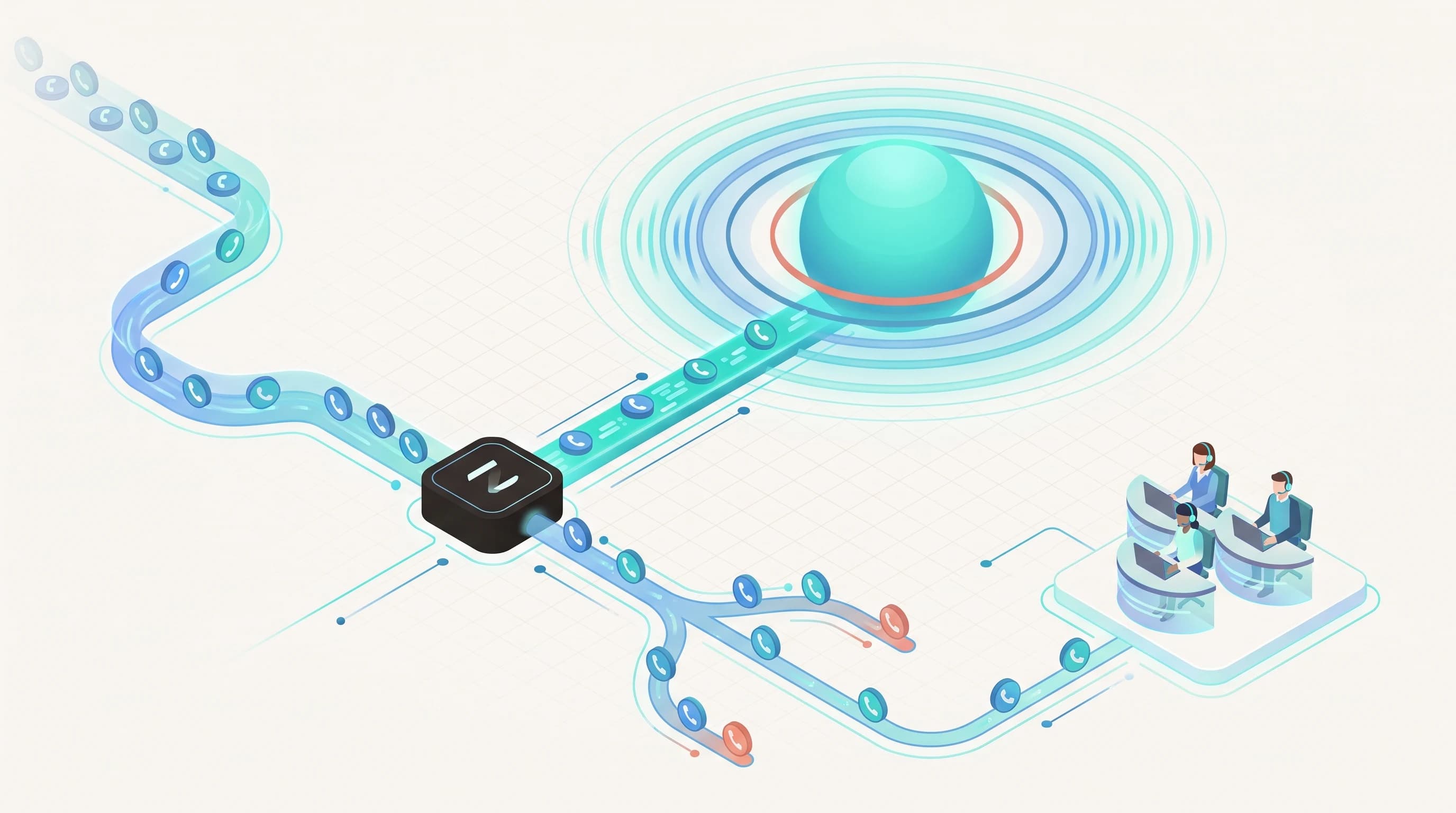
- Automate the routine 60 to 70 percent. An AI voice agent answers instantly, at any hour, and completes the task. No hold time, no menu tree, no "your call is important to us."
- Route the remaining 30 to 40 percent to humans. The emotional calls, the genuinely complex ones, the escalations - these still belong to a trained person, in-house or outsourced. And now your humans only ever get the calls that need them, which is a better job and a lower churn risk.
An illustrative example makes the leak visible. Say you handle 2,000 inbound calls a month at 4 minutes each. If 65 percent are routine and you keep paying a fully loaded human rate for all of them, you are spending on roughly 1,300 calls that a voice agent could resolve at a fraction of the cost. Move those, and you keep your human team for the 700 calls where their judgment is actually worth what you pay for it. (Treat the split as illustrative - your own call log is the only number that matters.)
Where each model wins
None of the three is "best." They win in different places.
- Outsourced humans win on high-empathy, sensitive, or highly variable calls, and when you need to stand up capacity fast without hiring.
- In-house software wins when calls are core to your brand and you want total control of the experience and the data.
- AI voice agents win on volume, speed, availability, and cost for the large routine slice - and they never call in sick or leave after 14 months.
The reason to think of them together is that they plug into the same backbone. An AI voice agent that can book an appointment, update a CRM record, or check an order status is really an AI automation layer wearing a phone number. The same integrations that let it answer a call let it text a confirmation, log the interaction, and hand a warm summary to a human when it escalates. Buy the phone piece in isolation and you get a smarter IVR. Buy it as part of your automation stack and you get a system.
If you are still deciding between building this on a platform like Retell, Vapi, or Bland, our breakdown of Retell vs Vapi vs Bland covers how those infrastructure choices differ. And if what you actually need is just after-hours message-taking rather than full call resolution, read AI answering service first - it is a smaller and cheaper problem.
Common mistakes when buying inbound call center services
A few patterns show up again and again:
- Buying capacity before mapping calls. Signing a 10-seat contract before you know that seven of those seats would answer the same five questions all day.
- Confusing an answering service with a call center. Paying for message-taking when callers expected their problem solved, then wondering why satisfaction did not move.
- Treating AI as all-or-nothing. Either refusing to automate anything, or trying to automate the emotional escalation calls that should always reach a human.
- Ignoring the integration layer. A voice agent that cannot see your order system or write to your CRM is a demo, not a solution. The value lives in the connections.
The decision rule
If you remember one line from this guide, make it this: buy human inbound call center services only for the calls that need a human, and automate everything that follows a script.
The old model made you pay a person rate for every call because there was no other option. In 2026 there is. The routine 60 to 70 percent of your inbound volume can move to an AI voice agent that answers instantly and never leaves, while your people - in-house or outsourced - handle the calls where judgment and empathy are the product. That is not cutting service. It is spending your service budget where it actually changes the outcome.
When you want that split drawn for your real call log - which calls the agent owns, which it hands off, and how it plugs into the tools you already run - that mapping is exactly what our voice AI team does before recommending anything. Send us a week of your inbound calls, and we will show you where the leak is.