
Type "white label partnership" into Google and you get a wall of guides that all answer the same question: what is it, and how do I sign one? Fair enough. But that is not the question that decides whether the partnership makes you money.
The real question is the one none of those guides answer: once the contract is signed and the first client is sold, who actually delivers the work, and does the way it gets delivered leave you a margin worth keeping?
A white label partnership is sold as a sales opportunity - add a service, resell it, pocket the difference. It is really a delivery operation wearing a sales pitch. Get the delivery layer right and it is one of the fastest ways to grow an agency. Get it wrong and you have bought yourself a support burden with a thin markup on top. This guide is about the layer the roundups skip.
What a white label partnership actually is
Strip away the language and a white label partnership is a division of labor. One company builds and fulfills a service. Another company rebrands it, sells it, and owns the client. The provider stays invisible. Your logo goes on the work.
That split is the whole appeal. You get to offer SEO, paid ads, a CRM platform, voice AI, or reporting without building the team that delivers any of it. Your client sees one brand - yours - and never knows a second company exists.
It is worth separating this from a term it gets confused with. If you are weighing exclusivity against speed, our breakdown of white label vs private label covers why one generic product resold by many partners behaves very differently from a product built for you alone.
The three ways the money is structured
Almost every white label partnership prices itself one of three ways. The structure matters because it decides where your risk sits.
| Model | How you pay | Where the risk sits |
|---|---|---|
| Fixed license | Flat monthly fee | You, if you undersell |
| Subscription markup | Wholesale rate, you set retail | Shared |
| Revenue share | A cut of what you collect | The provider |
A fixed license, like a platform you rebrand for a flat monthly fee, rewards you for selling volume because the cost does not move. A subscription markup lets you buy at wholesale and set your own retail price. A revenue share ties the provider's income to yours, which aligns incentives but usually means a smaller slice for you.
As an illustration of the markup model: a partner paying 400 dollars wholesale for a managed service and charging the client 1,000 dollars keeps 600 dollars before their own costs. Revenue shares in the market are commonly quoted in the range of 60 to 80 percent to the selling partner, though treat that as a typical band rather than a rule, since every provider sets its own terms.
Platform partnerships make the license model concrete. GoHighLevel's Agency Pro plan at 497 dollars per month unlocks its SaaS Mode, letting an agency spin up rebranded sub-accounts and resell the platform under its own name with its own markup. HubSpot runs a tiered version of the same idea through its Solutions Partner Program, where partners resell and service the product and move up tiers as they grow. Both are white label partnerships. The pricing structure just changes who carries the downside.
The part every guide skips: delivery is the whole game
Here is what the top-ranking guides on this keyword leave out. They cover types, benefits, and how to pick a partner. Not one of them covers the thing that actually determines profit: how the work gets delivered, client after client, without your margin leaking away in coordination.
Because that is where a white label partnership quietly fails. The contract is signed, the first client is happy, and then you sell a fifth and a tenth. Suddenly you are the human router between your clients and your provider - forwarding requests, chasing status, translating complaints, copying updates from one system into another. None of that is billable. All of it eats the margin the markup was supposed to protect.
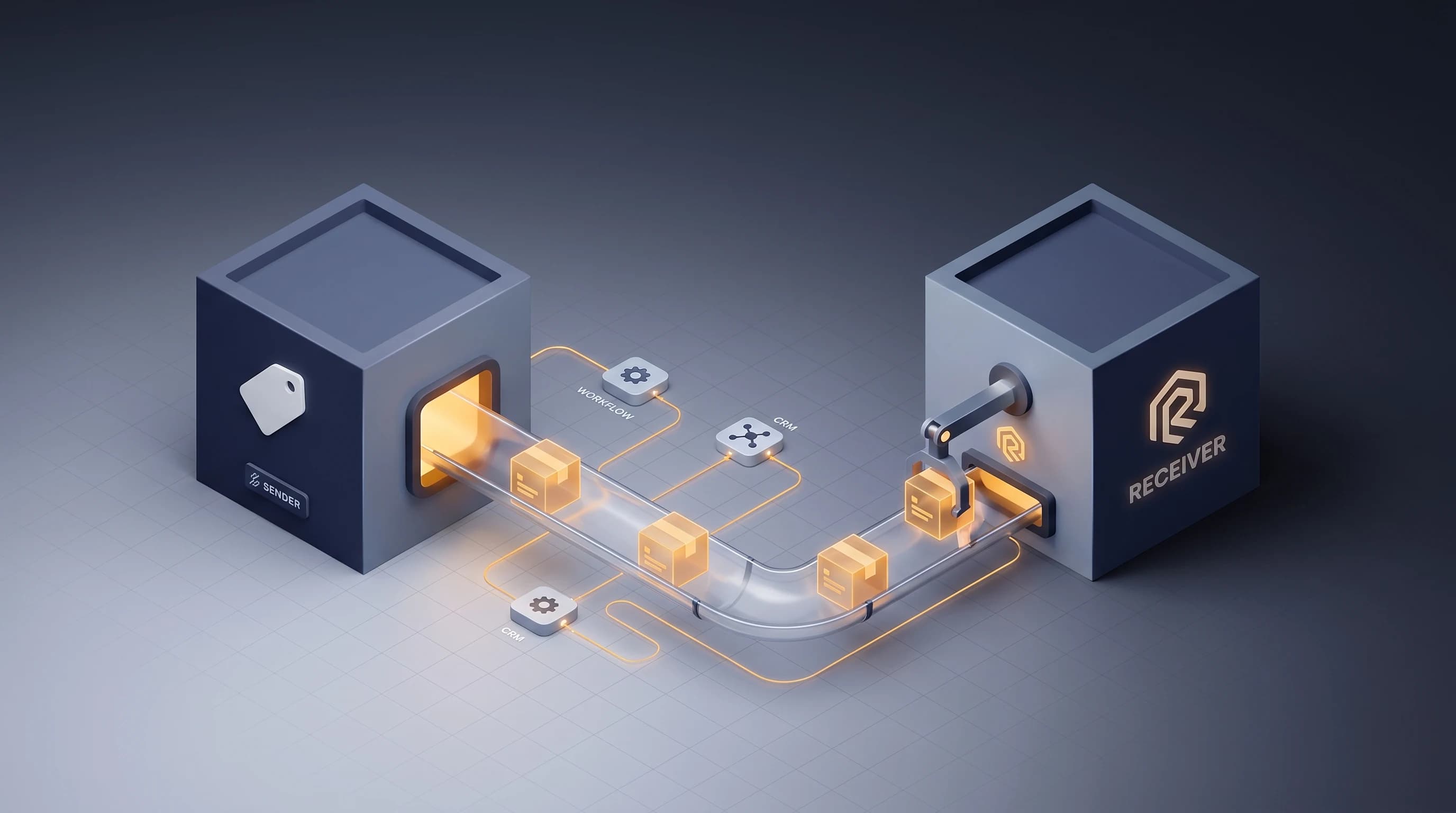
The agencies that make white label partnerships genuinely profitable are not the ones with the best contract. They are the ones who automated the handoff. When a client submits a request, it lands in a system that routes it to the provider, tracks its status, and pushes updates back to the client without a person retyping anything. That plumbing is the difference between a partnership that scales and one that turns you into an overworked middleman.
What actually decides your margin
Run the example math. Say you resell a service at a 600 dollar monthly markup across ten clients. On paper that is 6,000 dollars of margin a month.
Now subtract the reality. If every client generates two support touches a month, and each touch costs you fifteen minutes of coordination between your client and your provider, that is five hours a month of unbilled routing per handful of clients. Scale that to fifty clients and you are running a part-time coordination job you never priced for. The 600 dollar markup is still on the invoice. The take-home is not.
This is why the delivery layer is not a nice-to-have. Automating intake, routing, and status reporting is what keeps that 6,000 dollars closer to 6,000 dollars. Wiring your reseller operation into a CRM and workflow backbone - so requests, updates, and billing move without manual copying - is exactly the kind of build our white label service is designed around, because the margin lives in the operations, not the markup.
How to choose a partner without buying a demo
Because delivery is the game, judge partners on delivery. The sales deck is not the product. The fulfillment process is.
- Ask how work actually gets done. Who does it, how fast, and what happens when it breaks at 5pm on a Friday.
- Check the integration surface. Does their system connect to the CRM and tools you already run, or will you be the integration, copying data by hand between two dashboards.
- Get references at your volume. A provider who is smooth at five clients may fall apart at fifty. Talk to a partner running the volume you are aiming for.
- Confirm who owns the data. If the relationship ends, do you keep the client records and history, or does it all live in the provider's system. This is the same lock-in question that separates a real value added reseller from a rebadged affiliate.
- Pressure-test communication. Slow or vague answers during the sales process are the fastest version of the relationship you will ever get. It only gets slower after you sign.
If you are building the partnership on a platform rather than a service, the same rigor applies to the tooling. Our guide to running a GoHighLevel white label setup walks through what it takes to resell a platform under your own brand without the operational cracks showing to your clients.
The contract matters less than the handoff
Every guide tells you to get the contract right. You should. A clear agreement on responsibilities, SLAs, and data ownership protects you when things go wrong.
But the contract is a document you read once when there is a dispute. The handoff is something your clients experience every single day. A perfect contract with a broken handoff still produces angry clients and a shrinking margin. A plain contract with an automated, reliable handoff produces renewals.
Spend your energy accordingly. Negotiate the contract in an afternoon. Then spend real time on the operational layer - the intake form, the routing, the status updates, the billing - because that is the part your clients actually feel and the part that decides whether this partnership is a growth engine or a second job. If you want that layer designed and automated end to end, that is what our AI automation team and GoHighLevel automation team build for agencies scaling a reseller model.
Your next step
Do not start by comparing white label providers. Start by mapping your own delivery.
Take one service you want to resell and draw the full path a single client request travels: where it enters, who it goes to, how the work comes back, and how the client hears about it. Mark every point where a human has to move information from one place to another by hand.
Every one of those marks is a leak - a place where your markup turns into unpaid coordination as you add clients. Fix those before you sign anything, and a white label partnership becomes what it was always sold as: a way to grow revenue without growing headcount. Skip that step, and you will feel the difference around your tenth client, when the markup is still on the invoice but the margin has quietly walked out the door.
When you would rather have that delivery layer built before the tenth client instead of after, that is the exact operation our white label service sets up - the CRM, the routing, and the reporting that let you resell under your own brand without becoming the middleman between your clients and someone else's team.