

We used to build everything on Zapier. Now we use it for maybe 10% of client work. Not because Zapier got worse. Because the math stopped working at the volume our clients run.
This is the honest tour of what we use instead, when each Zapier alternative actually wins, and the migration cost nobody puts in their pricing pages.
TL;DR
- The reason to leave Zapier is almost always pricing at scale. Below 5,000 tasks per month, stay.
- Make is the cleanest direct swap for visual-first builders.
- n8n is what we default to for production work, especially anything AI.
- Pabbly Connect is the budget pick for SMBs running 10 to 30 Zaps.
- Power Automate is the right answer if you live in Microsoft 365.
- Activepieces is the closest open source alternative with a Zapier-like UI.
- Pipedream is for engineers who want code in their workflows.
- Migration is harder than the marketing pages claim. Plan 30 to 60 minutes per Zap rebuild.
Why people actually leave Zapier
Before recommending any alternative, the diagnosis. Each platform below solves a specific Zapier pain. Pick by pain, not by feature list.
The bill keeps growing. This is the most common reason. A Zapier task is every step that fires. A 5-step Zap running 10,000 times per month uses 50,000 tasks. The $49 Professional plan caps at 2,000. The leap to Team at $399/mo feels punitive when you do the math.
Zaps cannot do what you need. Zapier's branching is shallow. Paths exist but get awkward beyond 2 levels. Loops and iterators are limited. If your "automation" is becoming a workflow that needs real logic, Zapier strains.
You want to self-host. Compliance, data residency, cost control. Zapier is cloud-only. n8n, Activepieces, and a few others self-host for $20-50/mo on a basic VPS.
You need AI workflows. Zapier ships AI nodes but they feel bolted on. n8n's native AI Agent node, Flowise's agent canvas, or Make's AI module library are more capable for serious agent work.
Connector you need is missing. Rare these days (Zapier has 8,000+) but it happens. Niche regional CRMs, B2B tools with no public docs, legacy systems. Sometimes another platform has the integration you need.
If none of these match, you don't have a Zapier problem. You probably have a Zap design problem. Audit your top 10 highest-task Zaps before evaluating alternatives. Inefficient Zaps account for most surprise bills.
The seven that matter in 2026
1. Make (formerly Integromat)
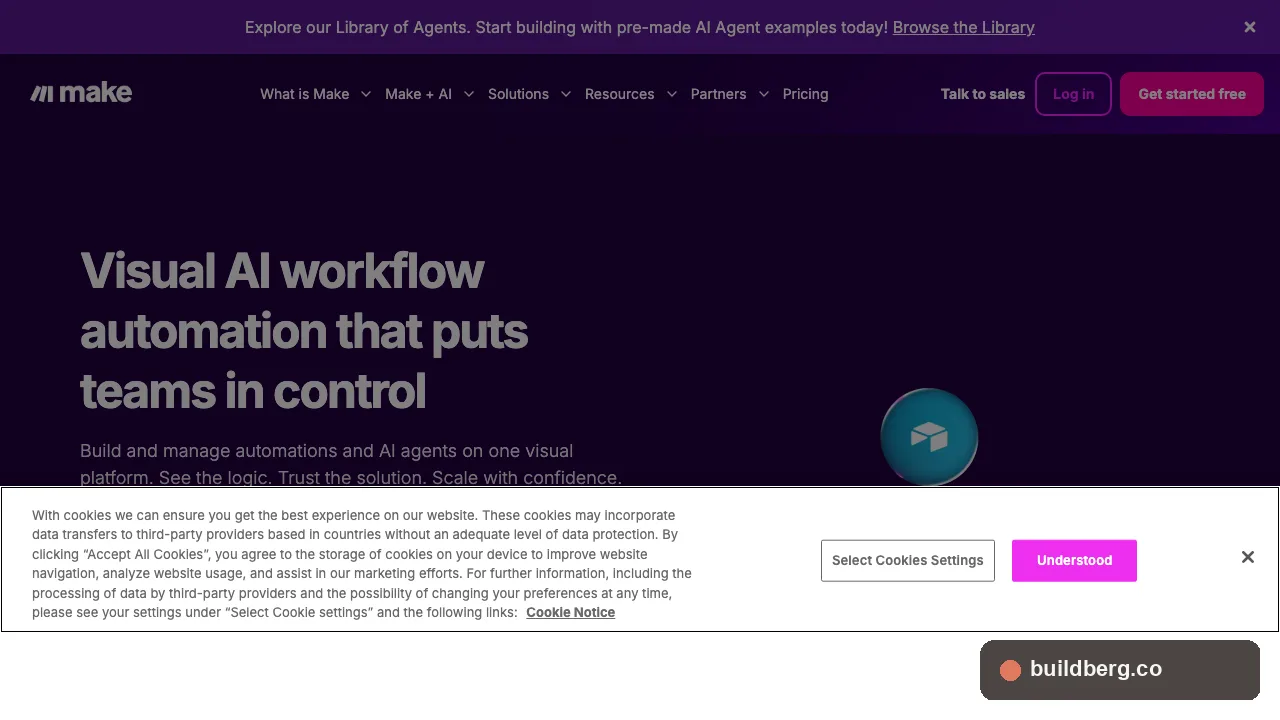
Best for: visual-first teams, marketing operations, Zapier shops that just want a cheaper version of the same thing.
Make's scenario canvas is the cleanest in the category. Routers, iterators, aggregators all live on the canvas without inflating your operation count the way they would inflate your Zapier task count. Build a 4-action workflow with a router and 2 paths in Make, you pay for 6 operations. Build the same in Zapier with paths, you pay for 4 to 8 tasks per run depending on which path fires.
The crossover math: above ~5,000 monthly executions of multi-step flows with branching, Make wins on price. Below that, Zapier and Make are roughly comparable.
What we use Make for: client projects where the client wants to maintain workflows themselves after handoff. The visual canvas is friendlier than n8n for non-engineers.
For the deeper comparison, see our n8n vs Make vs Zapier breakdown.
2. n8n
Best for: technical teams, AI agent workflows, anyone willing to self-host for dramatically lower costs at scale.
n8n is what we default to for production client work. Self-hosted on a $20/mo Hetzner VPS, n8n runs unlimited workflows with no per-task pricing. The crossover vs Zapier Cloud Professional ($49/mo, 2,000 tasks) happens almost immediately for most production use cases.
The AI Agent node is genuinely good. Native LangChain underneath, with vector store nodes, memory nodes, and tool nodes built into the visual canvas. For AI-heavy workflows, n8n is the strongest of the visual platforms.
The trade-offs: steeper learning curve than Zapier, smaller connector library (~600 vs Zapier's 8,000+), and self-hosting comes with ops overhead. Most n8n users we know either run their own VPS or pay n8n Cloud ($20/mo for the entry tier).
If you're considering n8n specifically, our n8n templates guide covers where to find production-ready workflows to start from.
3. Pabbly Connect
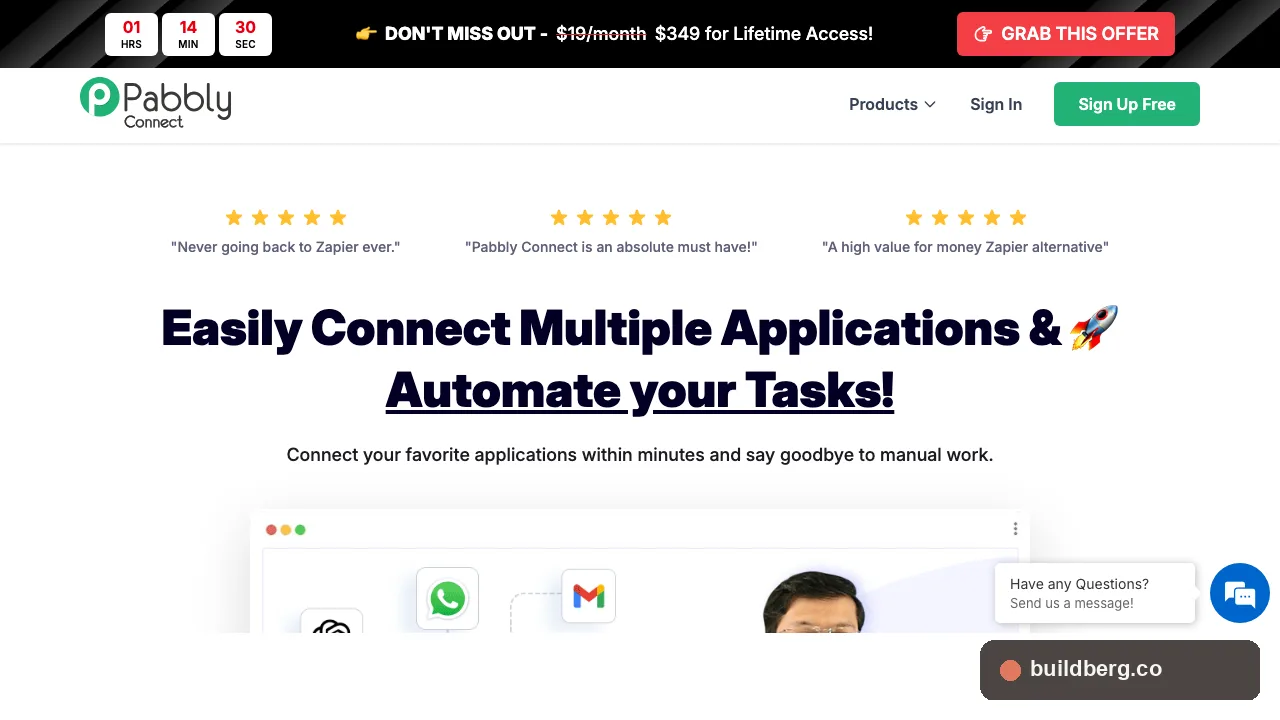
Best for: SMBs, agency owners running personal automations, anyone who hates recurring SaaS bills.
Pabbly Connect's pitch is direct: pay once, automate forever. Lifetime deals have been available on and off at $349 for 30,000 tasks per month forever. That breaks even against Zapier in under 6 months at moderate volume.
The trade-offs: UI is functional, not pretty. Connector list is smaller than Zapier (~1,500). Support is slower. But for an agency owner running their own internal Zaps, the price-to-performance ratio is hard to beat.
We don't use Pabbly for client work because most clients want to know they're using a "real" platform, but we know agency operators who run their entire back-office on it.
4. Microsoft Power Automate
Best for: companies on Microsoft 365 / Dynamics, enterprise compliance requirements, government and regulated industries.
If your stack lives in Microsoft 365, Power Automate is the obvious choice. It's bundled with most M365 plans (Premium gives you 1,000 cloud flows per user per month), so you may already be paying for it.
The good: deep Microsoft integration (Outlook, Teams, SharePoint, Dynamics), enterprise security (Azure AD, conditional access, DLP policies), strong governance for IT teams.
The not-good: outside the Microsoft ecosystem, the connector experience feels like a second-class citizen. The premium connectors (Salesforce, ServiceNow, etc.) require additional licenses. The UI is heavier than Zapier or Make.
For non-Microsoft-shop teams, skip Power Automate. For Microsoft-shop teams, you're probably already using it whether you realize it or not.
5. Activepieces
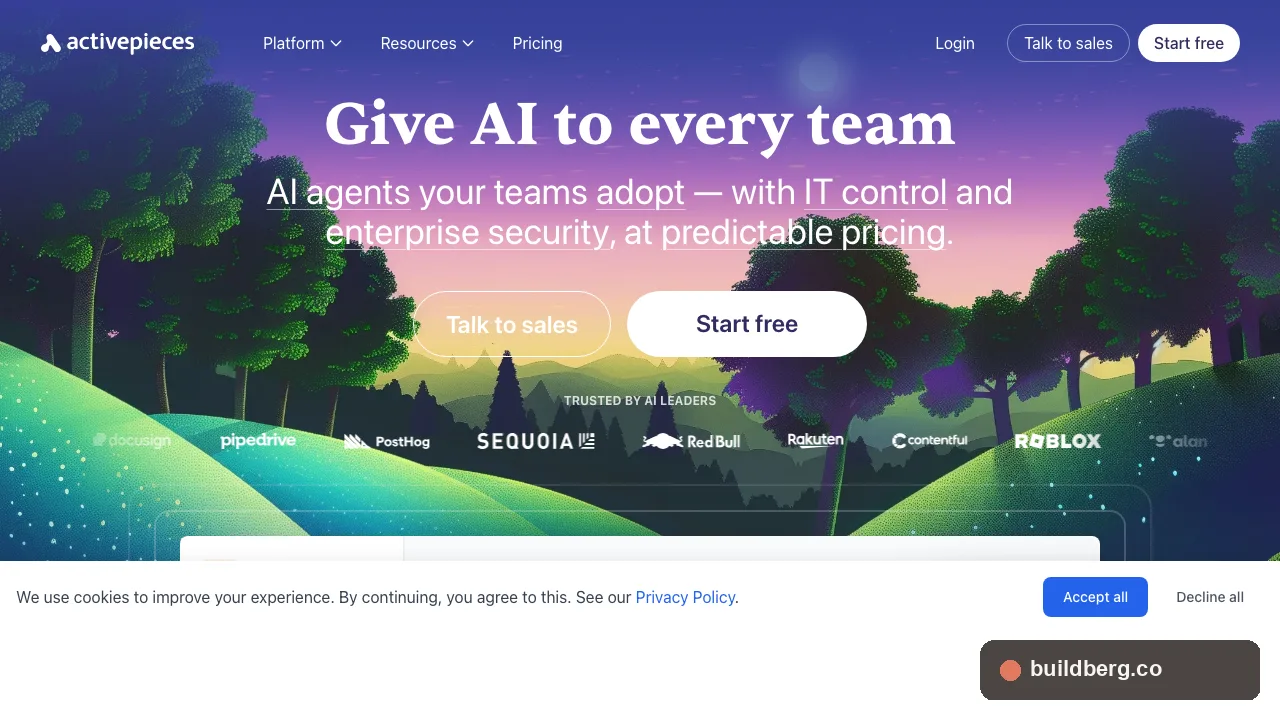
Best for: open source advocates, teams who want a Zapier-clone UI with self-hosting, anyone evaluating MIT-licensed alternatives.
Activepieces is the most direct open source Zapier alternative in 2026. MIT licensed, self-hosts via Docker, visual builder that looks deliberately Zapier-like. They've raised institutional funding (Sequoia among others) and are growing fast.
The trade-offs: connector library is smaller than n8n (~250 pieces vs n8n's 600+). Some advanced features (branching, loops) are less mature than Make or n8n. But the project moves fast and the licensing makes it easy to extend with custom pieces.
For a team that wants the Zapier model with full ownership, Activepieces is the strongest current pick.
6. Pipedream
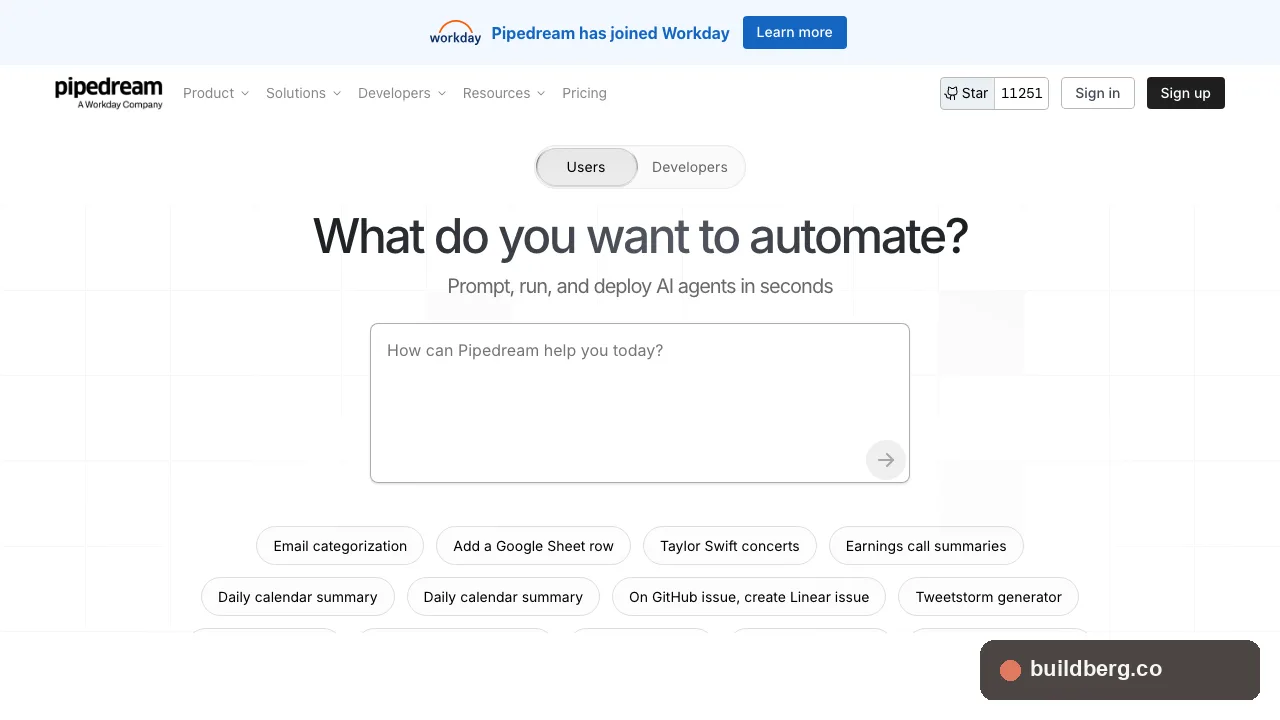
Best for: developers, engineering teams, workflows that are more code than configuration.
Pipedream is automation for people who'd rather write code than drag boxes. Every step can be Node.js or Python. Pre-built actions exist but the real value is the serverless runtime and the deep integration story.
The price model is unusual but generous: free tier gives 10,000 invocations per month. Paid tiers add credit-based scaling. For compute-heavy workflows, Pipedream often costs less than Make at the same volume.
We don't use Pipedream for client work because most clients aren't engineers and need to maintain workflows. For internal automation at engineering-led teams, it's an underrated choice.
Note: Pipedream was acquired by Workday in late 2025. Roadmap is now focused on enterprise integration. Independent operators have been wary but the platform itself hasn't changed much yet.
7. Zapier itself (with optimization)
Best for: teams running fewer than 5,000 tasks/month, non-technical owners who want zero ops overhead, anyone whose bill is high because of inefficient Zaps.
Don't sleep on this option. Most "Zapier is too expensive" complaints we hear get fixed by 30 minutes of audit work, not by switching platforms.
Common Zap inefficiencies that bloat task counts:
- Polling Zaps that should be webhooks (10x or more task savings).
- Multi-step Zaps that fire on every event when only some need processing. Add a Filter step early.
- Multiple Zaps doing the same thing because nobody consolidated them.
- Zaps that retry indefinitely on errors. Add error handling paths.
Optimize before switching. We've seen $400/mo Zapier bills drop to $99/mo from this kind of cleanup. That's better ROI than spending engineering hours migrating to a new platform.
What to skip in 2026
A few names appear in every "Zapier alternatives" listicle that aren't worth your time:
IFTTT - built for consumer automation. Stagnant connector library. Skip for business work.
Workato, Tray.io, MuleSoft - enterprise iPaaS platforms with enterprise pricing ($20,000+ per year minimum). Real products but if you're shopping Zapier alternatives, you're probably not ready for these.
No-code AI agent platforms (Lindy, Gumloop, others) - interesting but most are too young. Production workflows need stability.
The migration math
Same as it ever was. Here is the honest accounting.
Per Zap rebuild: 30 to 60 minutes for a faithful rebuild on the new platform, including auth setup and testing.
Validation overhead: another 20 to 40 minutes per Zap to run side-by-side and confirm output parity.
For an agency with 30 active Zaps: roughly 25 to 50 hours of engineering time. At $100/hr internal cost, that's $2,500 to $5,000 of opportunity cost.
A move from Zapier Team ($399/mo) to n8n self-hosted (~$20/mo VPS) saves $4,548/year. The migration pays back in 6 to 13 months. That's the right time horizon to evaluate against.
If you're paying $99/mo (Professional tier, 2,000 tasks) and migration costs $2,500, the payback period is over 2 years. Not worth it. Stay and optimize instead.
Our recommendation framework
Walk through this in order:
-
Audit current Zaps first. Find the top 5 task consumers. Fix obvious inefficiencies. Re-check the bill in 30 days.
-
Still painful at $400+/mo? Move heavy production Zaps to n8n self-hosted. Keep simple cross-app Zaps on Zapier.
-
Visual-first team that can't read n8n? Move to Make instead. Pricing is more graceful and the canvas is friendlier.
-
Microsoft shop? Power Automate is probably already in your license. Use it.
-
Open source requirement? Activepieces or n8n. Activepieces if you want a Zapier-style UI, n8n if you want more power.
-
Personal automations or back-office only? Pabbly Connect's lifetime deal pays back in months.
Closing thoughts
The "Zapier alternatives" market is loud because every alternative is paying for ads. The honest take is that Zapier is still the right tool for a lot of teams. Leave only when the math demands it.
When you do leave, expect to use 2 or 3 platforms in production rather than one. We've shipped client engagements running n8n + Make + Zapier simultaneously where each handled the workflows it was best at. That's not failure to commit. That's right-sizing.
If you want help making the call for your stack, tell us what you're trying to automate. We will tell you whether to leave Zapier or stay.
For deeper context on each platform, our n8n vs Make vs Zapier breakdown is the head-to-head, and the n8n alternatives guide is the parallel "when to leave n8n" piece. Together they cover the main migration paths.