Open almost any guide to ai automation for small business and the first recommendation is the same: pick an AI agent, a chatbot, or a voice bot, and point it at your biggest pain point. That advice is backwards for a business with five employees and no one whose job is to babysit software.
The standard pitch skips the part where someone has to maintain the thing. An AI agent that handles customer questions needs prompts updated, edge cases reviewed, and outputs checked for accuracy, ongoing work a five-person shop rarely has spare hours for. A plain rule-based automation, the kind that just moves data from one system to another on a trigger, mostly runs itself once it is built. For a small business, that difference decides whether the automation survives past month three.
TL;DR:
- The common advice to start small business automation with an AI agent or chatbot ignores the maintenance burden those tools create.
- Rule-based automation (missed-call text-back, lead routing, reminders) should come first because it is cheap, no-code, and mostly self-maintaining.
- AI belongs at the judgment-call layer on top of that foundation, not as the starting point.
- Real-world cost for a small operation runs roughly 100 to 600 dollars a month, based on published vendor pricing tiers.
Why "automate everything with AI" is the wrong starting order
AI adoption among small businesses has moved fast. The U.S. Chamber of Commerce reports that 58 percent of small businesses now self-identify as using generative AI, up from 40 percent in 2024 and more than double the 2023 figure. Adoption is not the problem. What that data does not show is how much of that usage survives past the first few months once nobody has time to keep tuning it.
That gap shows up at the enterprise level too, where resources are far less constrained than a small business. S&P Global Market Intelligence's Voice of the Enterprise survey of over 1,000 companies found that 42 percent abandoned most of their AI initiatives in a single year, up from 17 percent the year before, and that the average organization scrapped close to half its AI pilots before they reached production. If companies with dedicated AI teams abandon initiatives at that rate, a five-person business adding an AI agent with no one assigned to maintain it is taking on the same risk with none of the safety net.
The fix is not avoiding AI. It is sequencing it correctly, with rule-based automation first and AI added only where a judgment call is genuinely required.
What "ai automation" actually means at small-business scale
Three distinct things get called "AI automation," and mixing them up is where most of the wasted spend happens.
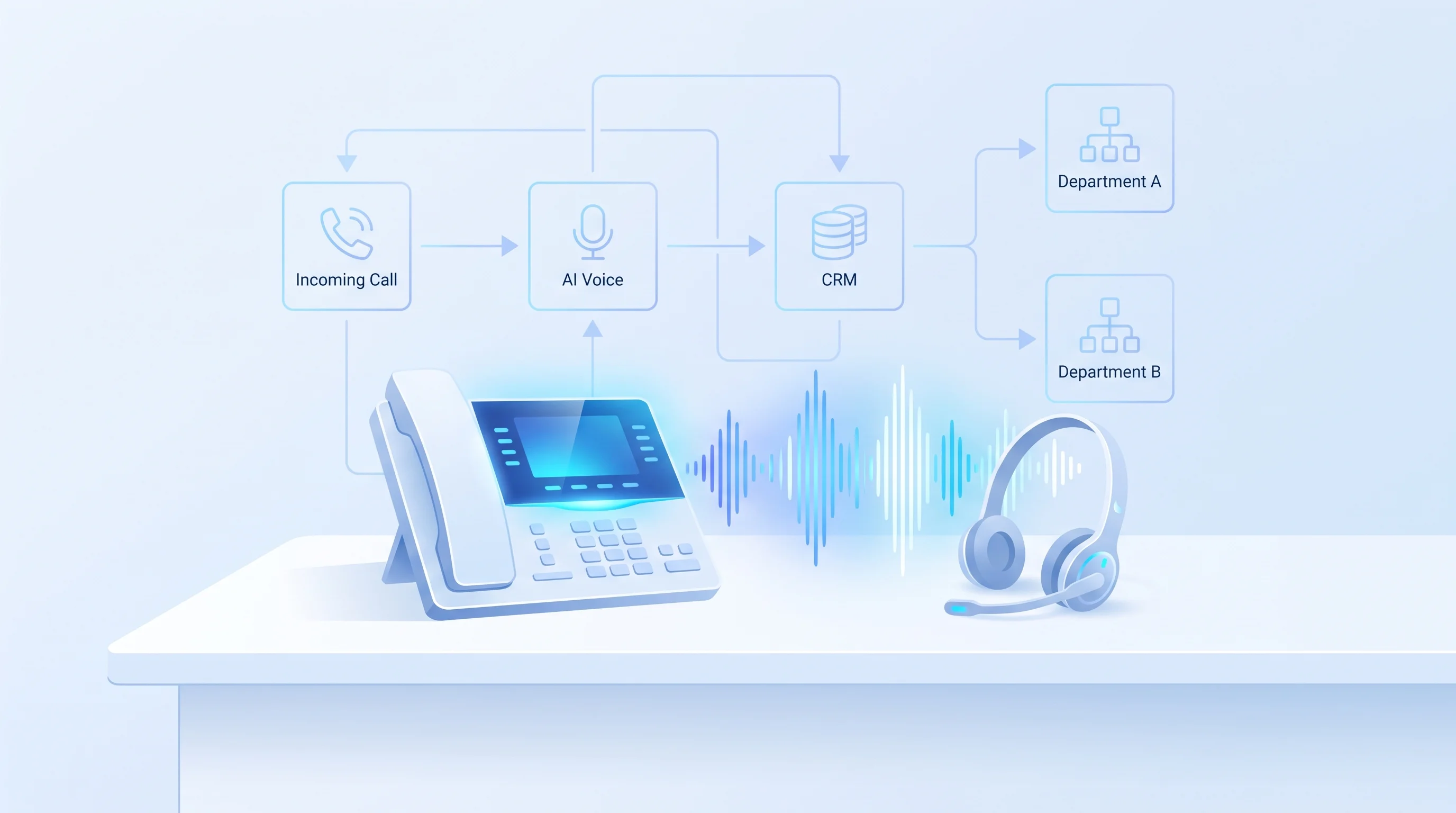
Rule-based automation moves data between systems on a trigger with no AI involved: a new lead form submission creates a CRM record, a missed call triggers an automatic text back, an invoice due date triggers a reminder email. No judgment required, which means no ongoing tuning required either.
AI-assisted automation adds a model at one step of an otherwise fixed workflow, like summarizing a call transcript or drafting a reply for a human to approve before it sends. The workflow structure stays rule-based; the AI only touches the one step that benefits from language understanding.
AI agents make decisions and choose their own next step, like a voice agent handling a customer call end to end or a support agent deciding whether to escalate a ticket. This is the most capable tier and also the one that needs the most ongoing review.
Our AI automation team builds all three tiers, but for a small business the build order below determines whether the investment pays off.
The build order that actually works for a small team
- Fix the leaks first. Missed-call text-back, lead-form auto-routing, and payment or appointment reminders are rule-based, no-code, and typically recover revenue the business is already losing through delay. These run through workflow automation tools and need essentially no maintenance once configured. A plumbing company that texts back every missed call within sixty seconds, for example, is not doing anything AI-driven, it is just refusing to let a lead go cold because no one was free to pick up.
- Add AI at exactly one judgment point. Once the rule-based layer is stable, add an AI step where a human currently has to read and decide, like triaging which inbound leads are worth an immediate callback versus a next-day follow-up. This is also where AI earns its cost: it replaces a few minutes of judgment per lead, not an entire job function.
- Consider an agent only once volume justifies it. A voice agent or full conversational agent makes sense once call or ticket volume is high enough that the agent's upkeep, reviewing transcripts, correcting misroutes, updating its scripts as the business changes, is cheaper than the hours it saves. Below that volume, the maintenance cost usually exceeds what it recovers, and a part-time answering service or a simple rule-based router does the job for less money and less risk.
Each step should run for a few weeks before adding the next. A business that layers all three at once loses the ability to tell which part is actually responsible when something breaks or when a customer complains about a missed handoff.
What it actually costs
As an illustration of what this looks like in practice: a small business running a rule-based automation platform plus one AI-assisted step typically lands in the 100 to 600 dollar a month range, scaled to call or lead volume. This is example math built from published pricing tiers, not a quote, since actual cost depends on usage and which tier that usage requires.
For context, Zapier's published pricing starts at a free 100-task plan and scales through paid tiers priced by monthly task volume, which fits a business automating a handful of workflows at low volume. GoHighLevel's pricing page lists a Starter plan at $97 a month with unlimited contacts, which fits a business that wants CRM, lead routing, and missed-call automation under one platform instead of stitching several tools together. Which one costs less depends entirely on whether the business needs a single consolidated platform or a handful of point-to-point automations.
The part most cost breakdowns leave out is the setup time, not the subscription. A no-code rule-based workflow can usually be built in an afternoon by the owner or office manager. An AI-assisted step takes longer to get right, since someone has to write and test the prompt against real customer messages, not just the clean examples in a demo. Budgeting a few hours of setup and a week of monitoring after launch matters more than the monthly subscription line item, because a workflow that silently misfires for two weeks before anyone notices costs more in lost leads than any platform's price difference.
The next step
List the three places your business currently loses time or leads to simple delay: a call that goes unanswered, a lead that sits for a day before anyone follows up, an invoice nobody chases until it is overdue. Those three are the starting spec for ai automation for small business, not a shopping list for the newest AI agent on the market.
Tell our AI automation team what's on that list, and we'll show you which parts are a one-afternoon rule-based fix and which, if any, actually justify an AI layer on top.