Will an AI receptionist for HVAC companies actually book the job into your dispatch board, or does it just take a message and text someone on your team? That question decides whether the tool pays for itself in month one or sits unused by month three, and almost none of the comparison roundups ask it.
Most lists rank seven or eight tools by monthly price and voice-minute allowance, the same way they'd rank phone plans. That framing misses the part that actually determines whether an HVAC company gets value out of one: can it see your technician's real calendar, ask the right triage questions for a no-heat call versus a routine filter change, and write the booking into the software your dispatcher already uses.
TL;DR:
- The real differentiator for an ai receptionist for hvac companies isn't price, it's whether it writes directly into your dispatch software or just forwards a message.
- Invoca's Home Services Lead Conversion Benchmarks Report found only 52% of calls to home services businesses reach a live person, and ServiceTitan cites research putting the annual cost of those missed calls at $45,000 to $120,000 for a typical HVAC company.
- Emergency triage logic, not voice quality, is what separates a receptionist that protects your reputation from one that puts a gas-smell call on hold.
- Build vs buy matters here: a generic point tool is fine for a single-truck operation, but multi-crew HVAC companies usually need the integration depth a managed build provides.
What "AI receptionist for HVAC companies" actually needs to do
A home-service call is not a simple Q&A. The AI has to figure out what's actually wrong, how urgent it is, and whether a technician is free in that zone today, all inside a two-minute phone call from someone standing next to a dead furnace in January.
That means the job has three parts, not one:
- Qualify the equipment and symptom. System type, age, and what's happening, so the technician who shows up already knows what parts to bring.
- Triage urgency. No heat in a freeze and a gas smell are not the same call as a seasonal tune-up request, and the response has to differ.
- Book against a real calendar. Reading actual technician availability by zone, not just offering a generic callback window.
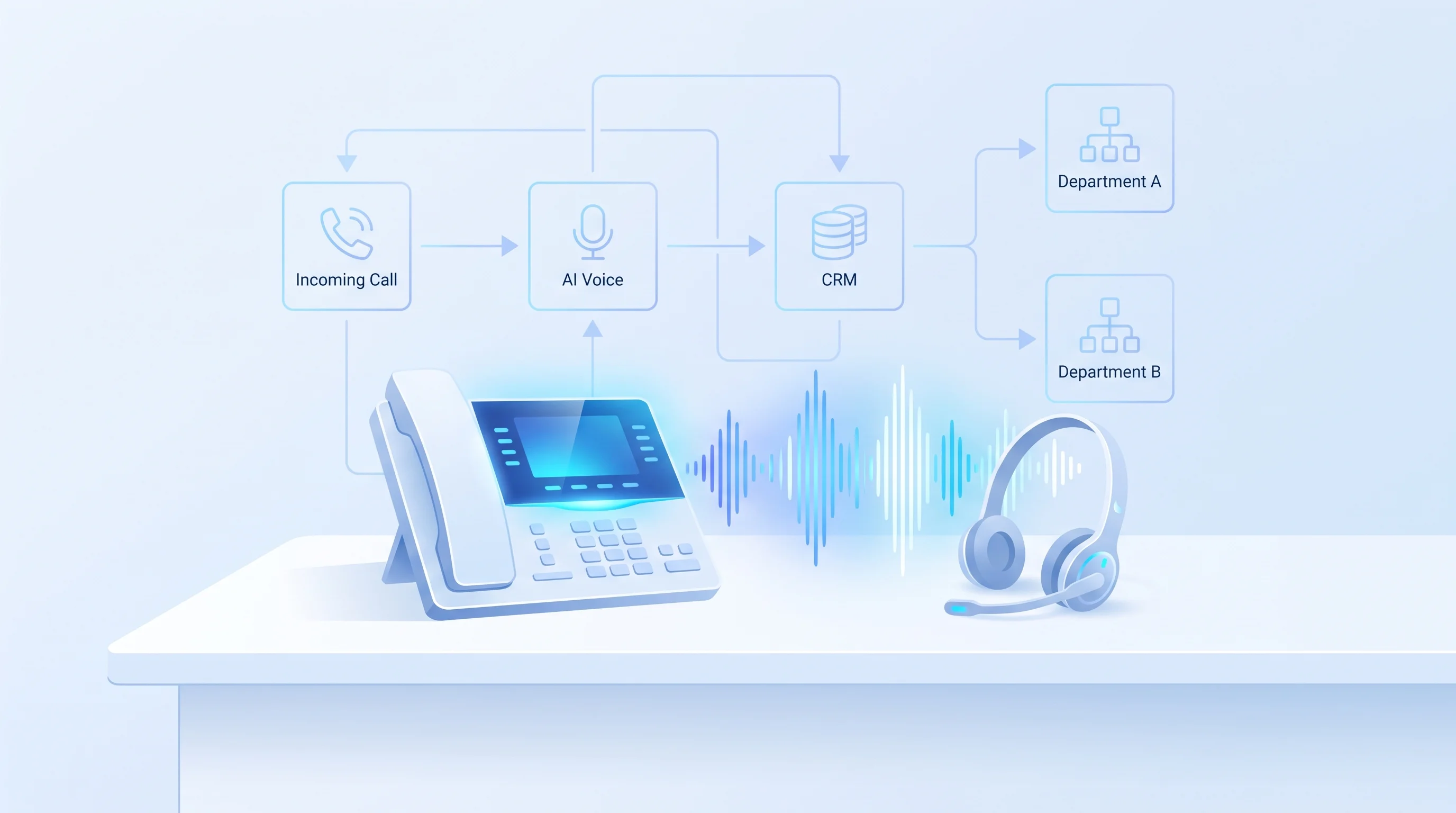
Our voice AI for home services builds work through all three because skipping any one of them turns the "AI receptionist" into an answering machine that happens to talk back.
The missed-call cost HVAC companies are actually eating
This is the number that should drive the buying decision, and most comparison posts bury it under a pricing table instead of leading with it.
Invoca's Home Services Lead Conversion Benchmarks Report 2026, built from an analysis of 70 million tracked calls across home service industries, found that only 52% of inbound callers reach a live person. That rate climbs to 65% for calls lasting over 15 seconds and 73% for calls over 30 seconds, meaning a huge share of the lost calls are ones nobody even picked up long enough to say hello.
ServiceTitan's article on AI virtual agents in HVAC, citing Invoca data, puts the missed-call rate at roughly 27% industry-wide and estimates the resulting annual revenue loss at $45,000 to $120,000 for a typical HVAC company. The same article notes that 78% of callers who reach voicemail never leave a message, which means most of those calls simply go to a competitor instead of into a queue you can follow up on later.
Point tool vs integration depth: the comparison the roundups skip
Nearly every "best AI receptionist for HVAC" list reviews point tools that take a call, capture the details, and text or email them to the business owner. That's a real improvement over a missed call, but it's not the same product as one that books directly into your dispatch board.
The difference shows up the first time call volume spikes. A text-and-message tool creates a backlog your office manager has to work through by hand during exactly the period, a cold snap or a heat wave, when they're already slammed. A dispatch-integrated agent checks technician availability in real time and puts the job on the board itself, which is the only version that actually removes work from your team instead of just relocating it from the phone to a text thread.
What to check before picking either kind:
- Does it write into ServiceTitan, Housecall Pro, Jobber, or GoHighLevel, or does it only generate a message for a human to re-enter?
- Can it see live technician availability by zone, or does it just offer a generic next-day callback window?
- Does it separate emergency and routine triage logic, or treat every call the same way?
If a vendor can't answer the first question with specifics, the tool is a smarter voicemail, not a receptionist. Our GoHighLevel automation builds often sit underneath exactly this kind of voice layer for HVAC clients already running their CRM and dispatch notifications through GoHighLevel, since the call booking and the follow-up sequence end up living on the same platform.
Getting emergency triage right
The hardest part of an ai receptionist for hvac companies to get right isn't the voice, it's the decision tree behind it. A furnace that stopped working overnight in a cold climate is not the same call as "my AC filter light is on," and the agent has to tell the difference without a human listening in.
A reasonable triage script asks about safety first: gas smell, carbon monoxide alarm, visible water damage, or no heat during freezing temperatures. Anything that flags should route to an on-call technician immediately, not sit in a queue waiting for business hours. Routine requests, tune-ups, filter questions, estimate follow-ups, get scheduled normally against the calendar.
Build vs buy for HVAC companies
A single-truck HVAC operation can usually get by with an off-the-shelf point tool at $30 to $100 a month, since call volume is low enough that a dispatcher can clean up the occasional message backlog by hand.
Multi-crew companies with weekend and after-hours volume hit a different math. As an illustration, if dispatch-integrated booking recovers even a handful of the service calls a point tool would otherwise lose to a text-message backlog, the difference in monthly cost is small next to the revenue of one additional booked job. That's the case for a managed build over a generic subscription once a business has more than one or two trucks and genuine after-hours call volume.
Key takeaways
- The decision that matters isn't which AI receptionist is cheapest, it's whether it writes directly into the dispatch software your crew already uses.
- Invoca's benchmark data puts the home services call answer rate at 52%, and ServiceTitan's own research estimates $45,000 to $120,000 in annual lost revenue from missed HVAC calls.
- Emergency triage logic, not voice quality, is what separates a receptionist worth trusting with a gas-smell call from one that just sounds polished.
- Single-truck operations can get by with a point tool. Multi-crew HVAC companies with real after-hours volume usually need the dispatch-board integration a managed build provides.
If your crews are missing calls during the exact hours a job would actually book, tell our voice AI for home services team which dispatch software you run on, and we'll show you what a properly integrated receptionist would have caught last month.