A client books a discovery call, buys a coaching package (say $2,000, as an illustration), and three weeks later asks if there's a self-paced course version she can resell to her own list. You already run the client's CRM, follow-up texts, and ad reporting on GoHighLevel. Now you're staring at a Kajabi sales page wondering whether you need a second subscription, or whether the platform you already have can just do this too.
That's the actual decision most people researching GoHighLevel vs Kajabi are making. It isn't a side-by-side feature war, because the two platforms were built to solve different problems from day one.
TL;DR:
- GoHighLevel's Starter plan is $97 a month with unlimited contacts and 3 sub-accounts; Kajabi's Basic plan is $179 a month and caps out at 2,500 contacts, according to each vendor's own pricing page.
- Kajabi is built for selling knowledge: courses, coaching, communities, and memberships to an audience you already have.
- GoHighLevel is built for running client relationships: CRM, pipelines, SMS, calls, and multi-client sub-accounts for an agency.
- Agencies that serve coaches and course creators often end up running both, connected through a webhook or Zapier, rather than picking one.
What each platform was actually built to do
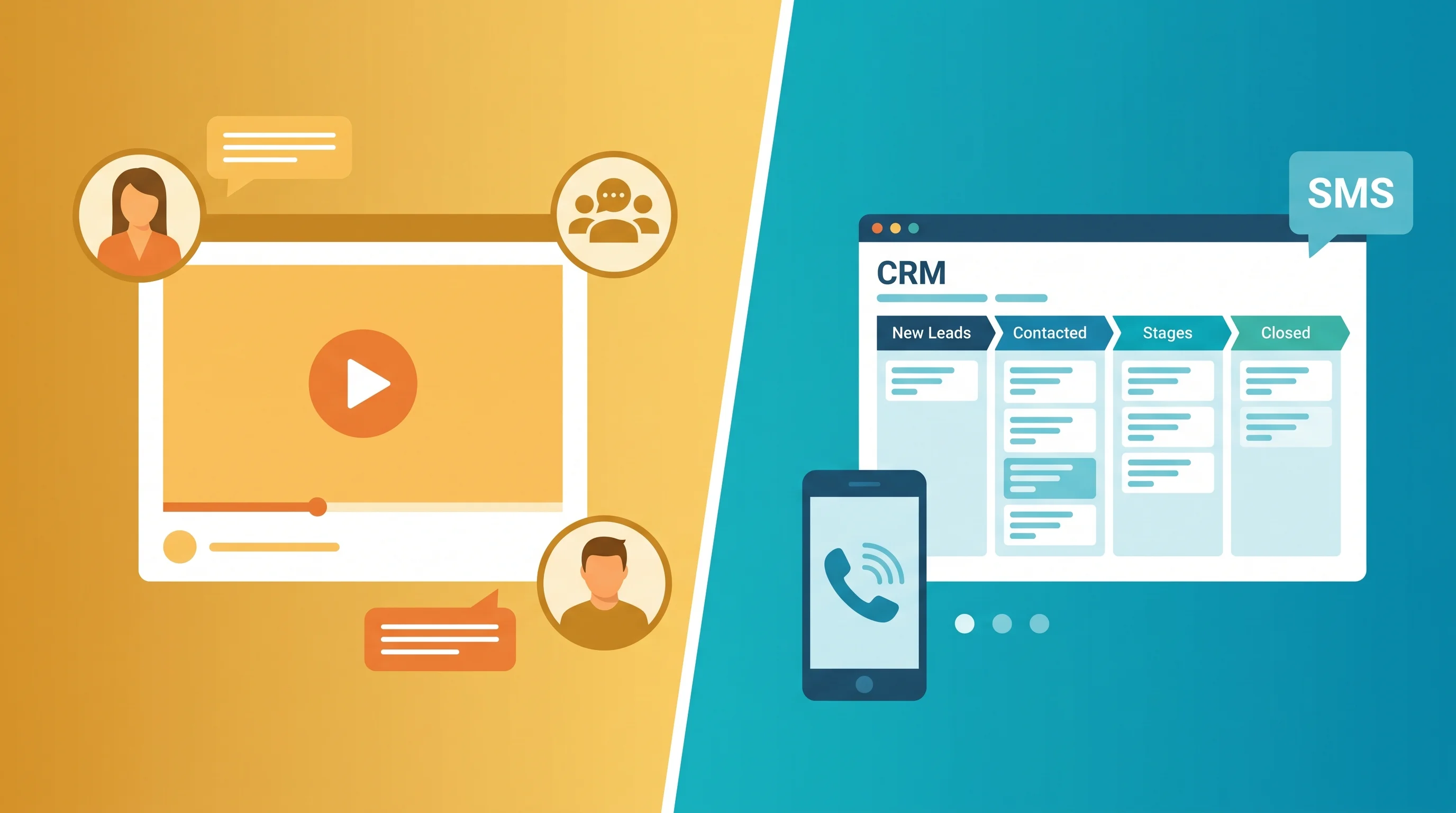
Kajabi started as a course hosting tool and has expanded into coaching, communities, memberships, newsletters, and podcasts. Its own features page leads with "online courses," "coaching programs," and "communities" before it ever mentions email marketing, according to Kajabi's features page. Everything in the product assumes you already have an audience and you're packaging knowledge to sell to it.
GoHighLevel started as a CRM and marketing automation platform for agencies running many client accounts at once. The core unit isn't a course, it's a contact moving through a pipeline, triggered by a missed call, a form fill, or a tag. Courses and memberships exist inside GoHighLevel, but they sit behind the CRM, not in front of it.
If you already know which of those two descriptions matches your business, the pricing and feature details below mostly confirm a decision you've half made. If you're not sure, that's the actual question to answer before comparing checkout flows.
Pricing: what the vendor pages actually say
| Plan | GoHighLevel | Kajabi |
|---|---|---|
| Entry | Starter, $97/mo, unlimited contacts, 3 sub-accounts | Basic, $179/mo, 2,500 contacts, 5 products |
| Mid | Unlimited, $297/mo, unlimited sub-accounts | Growth, $249/mo, 25,000 contacts, 50 products |
| Top | Agency Pro, $497/mo, unlimited sub-accounts | Pro, $499/mo, 100,000 contacts, unlimited products |
Figures above come directly from GoHighLevel's pricing page and Kajabi's pricing page, both current as of this writing.
The entry-tier gap is the clearest signal in the whole comparison. GoHighLevel's $97 Starter plan ships with unlimited contacts. Kajabi's $179 Basic plan caps you at 2,500 contacts and 5 products. That isn't Kajabi overcharging, it's a different pricing axis: Kajabi charges by how big your audience and catalog get, because that's the thing a course business scales. GoHighLevel charges by sub-accounts and users, because that's the thing an agency scales.
Where Kajabi wins outright
Kajabi's course builder has modules, drip schedules, quizzes, and a member portal with progress tracking built specifically for keeping a student moving through content, per Kajabi's features page. Its checkout supports order bumps, upsells, and payment plans natively. The Communities feature gives members a discussion space without bolting on a third-party tool like Circle or Discord.
None of that is a knock on GoHighLevel. It's just not what GoHighLevel's membership area was designed to be the best at. If the entire business is one flagship course or a coaching membership sold to a cold or warm audience, Kajabi's narrower focus is the point, not a limitation.
Where GoHighLevel wins outright
GoHighLevel's advantage shows up the moment a business has more than one "deal" moving through a pipeline at once, or needs to run the same stack across multiple client brands.
Native calling, SMS with A2P registration, workflow-triggered outbound texts, and a visual automation builder with triggers across every channel are core to the product, not an add-on. For service businesses, agencies, and anyone selling a high-touch offer that depends on fast lead response, that native phone and text layer matters more than a polished course player.
The multi-account structure is the other half. Through GoHighLevel automation, an agency can run SaaS Mode and spin up a branded, billed sub-account for every client from one master account, according to GoHighLevel's own SaaS Mode page. Kajabi has no equivalent. It's built for one brand, one catalog, one creator, not an agency reselling the platform under dozens of client logos.
The overlap, and where it actually breaks
Both platforms now sell "email marketing automation" and both sell "memberships," which is where a lot of comparison lists get lazy and call them substitutes. They aren't, once you look at what each does with those features.
Kajabi's automation is audience-segment driven: tag a contact based on what they bought or clicked, then send a sequence. It's built for nurturing a list toward a sale. GoHighLevel's automation is channel-and-pipeline driven: move a contact through stages, trigger calls, texts, and tasks, and hand off to a human the moment a condition fires. It's built for managing a relationship, not just a list.
Our GoHighLevel vs HubSpot comparison covers the same pattern from a different angle, enterprise CRM depth versus SMB automation breadth, and the GoHighLevel vs Kajabi split follows the same logic: pick the platform built around what you're actually selling, not the one with the longer feature list.
Can you run both at the same time
Plenty of agencies that serve coaches and course creators do exactly this: Kajabi hosts the course and handles the member experience, while GoHighLevel runs the CRM, the sales pipeline, the follow-up texts, and the reporting layer on top. There's no first-party integration between the two platforms, so the connection runs through Zapier, Make, or a direct webhook, pushing a Kajabi purchase or course-completion event into a GoHighLevel contact so the rest of the client's follow-up fires automatically.
If you're already running client fulfillment or agency work through white label services, this two-platform setup is common: Kajabi stays the product delivery layer under the end creator's own brand, while the CRM and automation work happens behind the scenes under yours.
What to take from this
- Kajabi is built to sell knowledge to an audience: courses, coaching, communities, and memberships are the product itself.
- GoHighLevel is built to run client relationships: CRM, pipelines, calls, texts, and multi-client sub-accounts are the product itself.
- GoHighLevel's $97 entry tier undercuts Kajabi's $179 tier on price, but the two charge for different scaling axes, so price alone isn't the deciding factor.
- If you sell one course or membership to an audience, start with Kajabi. If you run client relationships across a pipeline, especially for more than one client brand, start with GoHighLevel.
- Running both, connected through a webhook, is a normal setup for agencies serving course creators, not a sign you picked wrong.
If you're already leaning on GoHighLevel for CRM and follow-up and want the sub-account, billing, and automation side built properly, tell our GoHighLevel automation team what your current client setup looks like and we'll map out what SaaS Mode and workflow automation would actually save you.