How much does a white label chatbot actually cost to run, once you strip out the plan price shown on the pricing page? That is the question every comparison list sidesteps, and it is the only number that actually determines whether reselling one of these platforms makes an agency money.
Search "white label chatbot" and you get the same format from a dozen different sites: a table of vendor logos, a starting price, a star rating. What none of them show is what happens to your margin three months into a client relationship, once their chatbot is actually getting used.
TL;DR:
- Several popular white label chatbot platforms charge extra to remove their own branding. Chatbase prices that add-on at $99 a month, separate from the base plan and the same price regardless of tier.
- These platforms bill by conversation or message credit, not a flat seat fee. Chatbase's own pricing page lists 700 credits on its $40/month Hobby plan, up to 15,000 on its $500/month Pro plan, with extra credit blocks at $40 per 1,000 credits.
- Underneath those credits sits raw model usage. OpenAI's own pricing page lists GPT-4o at $2.50 per million input tokens and $10.00 per million output tokens, which is the kind of cost a credit system is built to mark up and simplify.
- The real risk isn't the vendor's price list, it's that a client's chatbot succeeding, meaning more conversations, directly raises your cost while your resale price to them usually stays flat.
What a white label chatbot actually is
A white label chatbot is a vendor's chatbot platform, rebranded with your logo, your domain, and your name on the invoice. The client sees your brand. The underlying model, infrastructure, and credit system all still belong to the vendor.
That's different from a custom-built chatbot, where you or a partner controls the integration, the model choice, and the usage cost directly instead of paying a vendor's marked-up credit price for it. Our white label AI agency breakdown covers that same rent-vs-build split at the business-model level; this post stays narrowly on chatbots and the specific cost structure that trips agencies up.
Both paths can work. The mistake is assuming "white label" means the same thing, and costs the same thing, across every platform that uses the term.
The badge fee most roundups bury
Here's a detail that rarely makes it into the comparison tables: on several platforms, "white label" does not mean branding-free by default. It means branding-free once you pay for it separately.
Chatbase's pricing page lists a dedicated add-on to remove the "Powered by Chatbase" badge, priced at $99 a month. That fee sits on top of whichever base plan you're already paying for, whether that's the $40/month Hobby tier or the $500/month Pro tier. Voiceflow takes a different approach and ties white-labeling to its "For Agencies & Partners" plan, which carries no published price on the pricing page itself, just a request-a-demo button.
Neither approach is dishonest. Both are easy to miss when you're scanning a feature grid instead of reading the actual pricing page line by line.
Why reselling gets more expensive exactly when the bot is working
This is the part the roundups skip entirely, and it's the one that actually determines whether reselling a white label chatbot is profitable past the first few months.
These platforms don't charge a flat seat price the way most SaaS tools do. They charge by conversation or message credit. Chatbase's own numbers: 700 credits on the $40/month Hobby plan, 4,000 on the $150/month Standard plan, 15,000 on the $500/month Pro plan, and $40 per additional 1,000 credits beyond that, according to Chatbase's pricing page.
Credits exist because the platform is passing through a real, metered cost underneath: the model doing the actual reasoning. As an illustration of what that raw cost looks like, OpenAI's pricing for GPT-4o runs $2.50 per million input tokens and $10.00 per million output tokens. A platform's credit system takes that kind of per-token cost, bundles it into a simpler unit, and marks it up.
That structure means the vendor's cost to you scales with how much the chatbot actually gets used. As an illustration, if you sold a client a flat $300/month retainer for "a white label chatbot," and their holiday traffic triples their conversation volume, you're the one absorbing the overage charge, not them, unless your contract already accounted for it.
Building the right pricing model before you resell
The fix isn't complicated, but it has to happen before you sign a client, not after the first overage bill shows up.
- Price in a usage band, not a flat number. Quote a base tier covering a set number of conversations a month, with a published per-conversation rate above that, mirroring the vendor's own credit structure instead of hiding it from the client.
- Confirm the branding cost in writing. Get the vendor's exact white-label fee, and at which tier it applies, before you build it into your own pricing. A $99/month add-on you forgot to pass through is a $99/month hole in your margin.
- Match the platform to the volume. Low-volume, single-channel use cases, like FAQ answering on one website, are where renting a platform like this makes the most sense. Multi-channel, CRM-connected, high-volume chatbots are usually cheaper to run through a custom build once volume passes a certain point, because you stop paying a vendor's credit markup on every single conversation.
- Revisit the contract every renewal, not just at signing. A client that doubled their site traffic since you quoted the original price is also doubling the conversation volume running through the vendor's credit meter. Build a usage check into the renewal conversation instead of discovering the overage on an invoice.
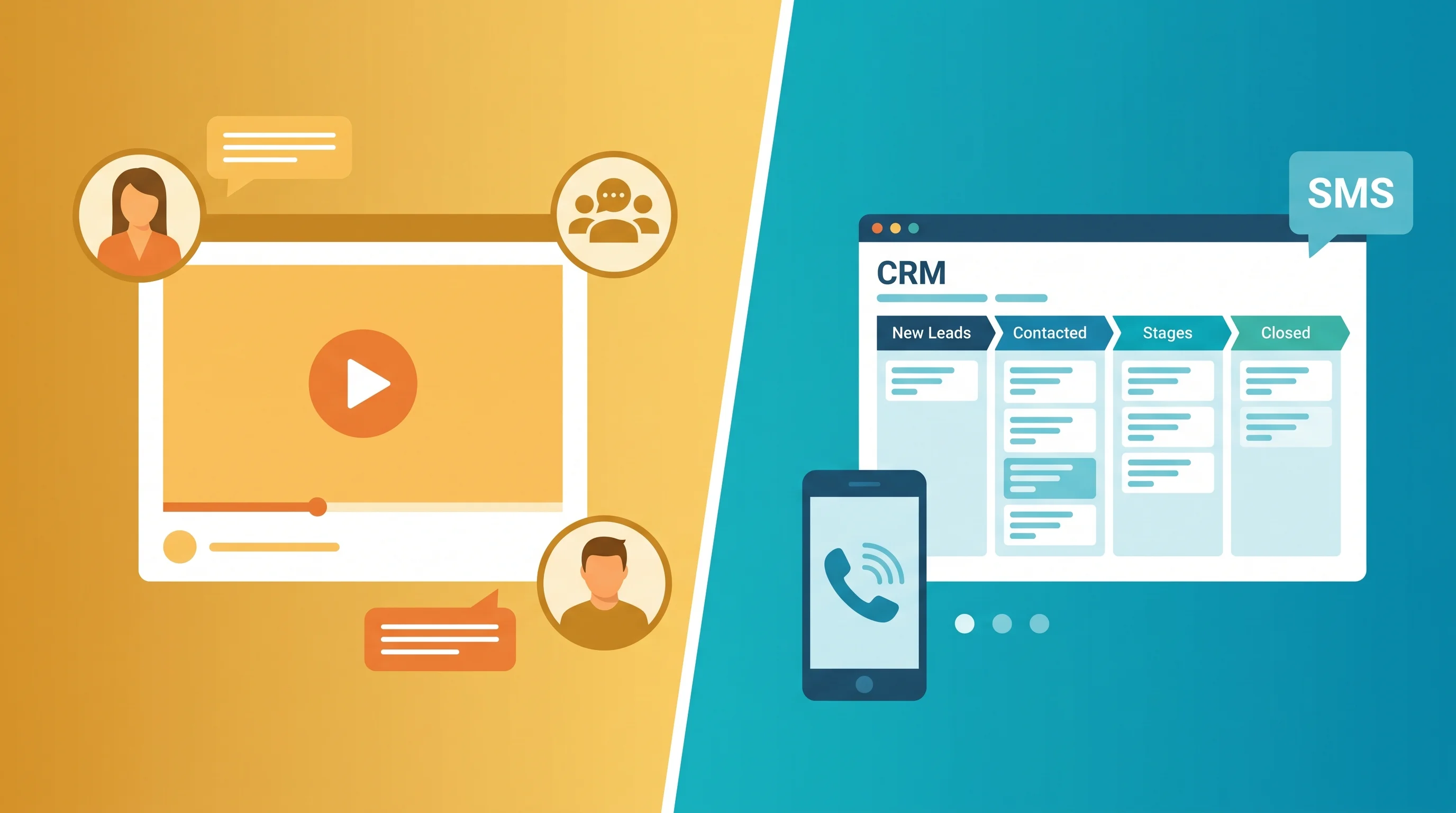
If a client's chatbot needs to read and write into their actual CRM, not just answer questions from a script, that's also the point where a rented platform's integration limits start to show. A platform built for a simple website widget usually has no native path into a client's pipeline stages or follow-up sequences, so any "integration" ends up being a human copying a transcript into the CRM by hand. Our AI automation team builds that connective layer directly, so a chatbot handoff can create a CRM record or trigger a follow-up sequence instead of just logging a transcript nobody reads.
What actually separates a good white label chatbot deal from a bad one
None of this comes down to picking the "best" logo on a comparison chart. It comes down to three numbers most pricing pages make you dig for: the base plan price, the exact cost of removing the vendor's branding, and the credit or conversation ceiling before overage charges start. A deal where all three are published and priced into your client contract is a fine deal, whichever vendor it's with. A deal where any of those three is still "custom, contact sales" by the time you sign a client is the one that eats your margin six months in.
Rented platforms also aren't the only option once volume or integration depth outgrows what a credit-based plan was built for. Tell our white label team what your client actually needs the bot to do, and we'll scope whether a rented platform or a direct build keeps more of the margin on your side.