
It is 9:14 on a Tuesday night. Someone who has been comparing three vendors all week finally fills out the contact form on your website. They are ready to talk. Then they close the tab and go to bed.
Your form emails you. You see it at 8:30 the next morning, reply by 9, and hear nothing back. By then they have already had a call with the competitor who answered at 9:16 the night before. You did not lose that lead on price or product. You lost it on eleven hours of silence.
That gap is the real problem AI lead generation solves, and it is not the problem most articles about it talk about. The typical guide hands you a ranked list of prospecting tools and calls it a strategy. But the tool is the least important part. What decides whether AI lead generation works for you is the system around it - how fast you capture the lead, how you qualify it, and where you send it next. This is the framing we use before we wire up anything in our AI automation practice.
What AI lead generation actually is
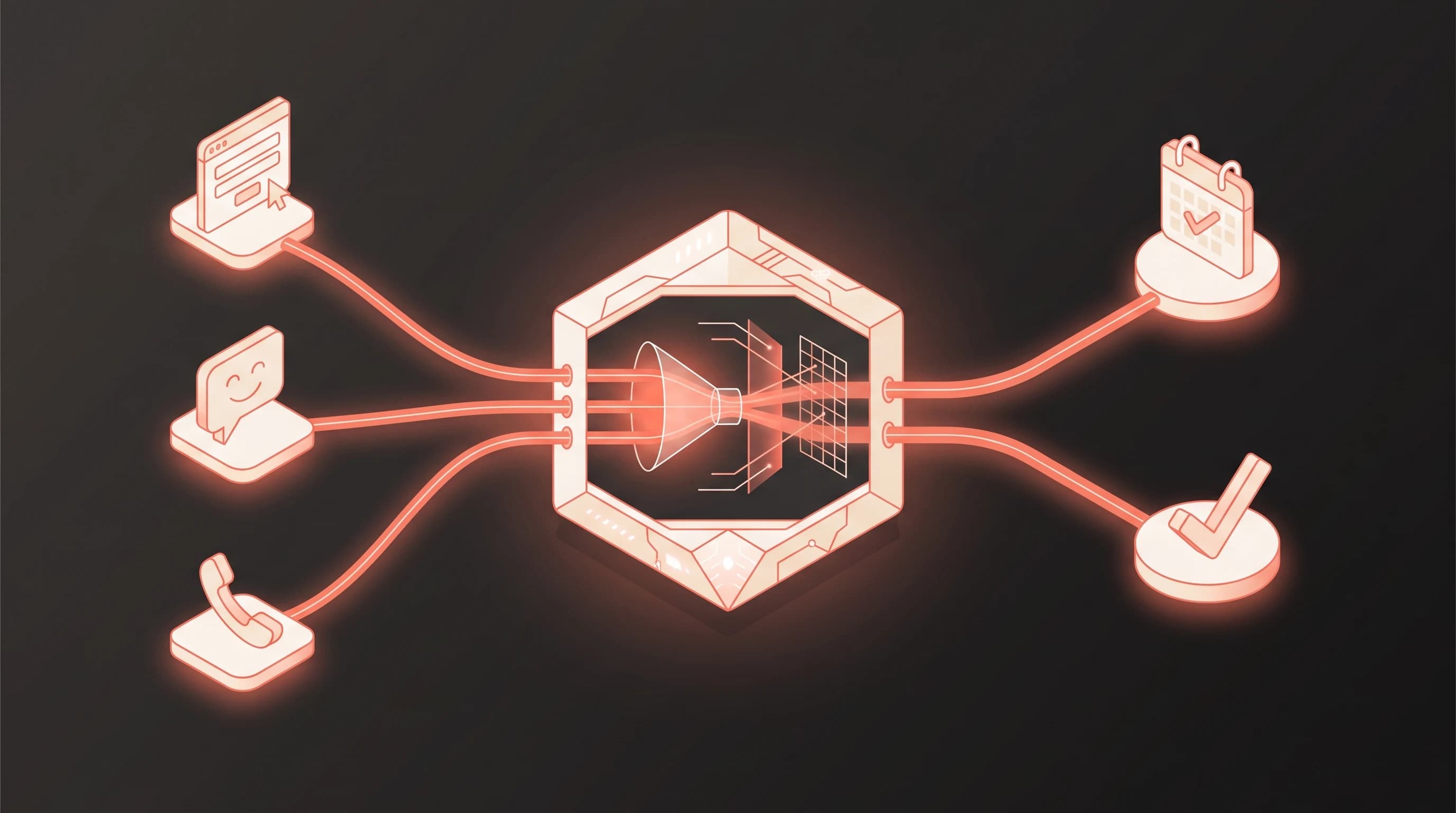
Strip away the tool logos and AI lead generation is three jobs done automatically:
- Capture. Catch the lead the moment they raise their hand - a form, a chat, a phone call, a reply.
- Qualify. Decide whether this lead is a real fit before a human spends time on them.
- Route. Send the right lead to the right next step, instantly and every time.
AI is what lets you do all three in seconds instead of hours, on every lead, at 9pm on a Tuesday. That is the whole game. A tool that finds you a thousand new prospects is worthless if you cannot respond to the ones already knocking.
Most of the confusion comes from lumping two different motions under one term. Outbound lead generation - finding cold prospects and reaching out - is one motion. Inbound lead generation - catching and converting people who already showed interest - is another. AI helps both, but for most small and mid-sized businesses the inbound side is where the money is leaking, because the leads are already there and going unanswered.
The mistake: buying a tool instead of building the system
Search "AI lead generation" and every result is a listicle of tools. Buy the tool, the pitch goes, and leads appear. It rarely works that way, because a tool with no system around it just generates more unanswered leads faster.
The system is what makes the tool pay off. And the single highest-leverage part of that system is not clever at all. It is speed.
Read that last number again. Almost a quarter of businesses that paid to generate a lead never replied to it. No AI tool fixes that. A system that responds automatically does.
Job one: capture without gaps
Capture means never letting a raised hand go unanswered, on any channel, at any hour.
The web form is the obvious one, but it is also the slowest. By the time an email notification reaches a human, the visitor is gone. An AI layer changes the shape of this: the instant a form is submitted, an agent can send a personalized reply, ask the first qualifying question, and open a conversation while the intent is still warm.
Chat is the same idea earlier in the funnel. A website assistant that answers questions around the clock and captures contact details turns anonymous traffic into named leads. We covered how these assistants work in conversational AI for business, and the pattern is the same one that powers an AI customer service agent: answer, capture, hand off.
The channel most businesses forget is the phone. A missed call is a lost lead, and after hours that is most of them. A voice agent that answers, qualifies, and books - the kind we build in our voice AI practice - closes the after-hours gap that quietly costs the most.
Job two: qualify before a human spends time
Not every captured lead deserves a salesperson. Qualification is deciding which ones do, and it is where AI earns its keep fastest, because it can ask and score on every single lead without getting tired or skipping the boring ones.
Two mechanics do the work:
- Conversational qualification. An AI agent asks the same few questions a good rep would - what are you trying to solve, what is your timeline, what is your budget - and records the answers. The fit leads get fast-tracked; the rest get a helpful reply and a lighter touch.
- Predictive scoring. The system weighs fit and intent signals - company size, pages viewed, questions asked - into a score that says who to call first.
The point of qualification is not to be clever. It is to protect your team's time. Sellers already spend most of their week not selling. Salesforce's 2026 State of Sales report, built on a survey of 4,050 sales professionals, found reps spend only around a third of their time actually selling, with the rest lost to admin, research, and data entry. AI qualification hands some of that time back by filtering out the leads that were never going to buy.
Job three: route so nothing stalls
A qualified lead sitting in an inbox is the same as an unqualified one: nothing happens. Routing is the connective tissue that moves each lead to its correct next step the instant it is ready.
Hot lead with budget and timeline? Book it straight onto a rep's calendar and notify them. Good fit but early? Drop it into a nurture sequence. Not a fit? Send a genuinely useful reply and stop wasting attention on it.
Routing is where lead generation meets operations, and it is pure automation - the same discipline behind our workflow automation work. Done right, no lead waits on a human to manually forward it, and every handoff is logged so nothing falls through a crack.
Where AI lead generation still fails
The honest part most vendor guides skip. AI lead generation breaks in predictable ways, and knowing them upfront saves you the disappointment.
- Garbage data in, garbage leads out. If your enrichment source is wrong about who a lead is, the AI will confidently qualify and route them wrong. Data quality is upstream of everything.
- Over-automation on the wrong step. Automating the first response is a clear win. Automating a high-stakes negotiation is not. Keep a human on anything involving real money or judgment.
- Personalization that reads like a robot. AI can draft outreach at scale, but scale without relevance is just faster spam. If the message could go to anyone, it converts like it went to no one.
- No feedback loop. A scoring model that never learns from which leads actually closed slowly drifts out of date. The system needs to see outcomes, not just generate activity.
For outbound specifically, the difference between a system that works and one that annoys people comes down to research quality. We wrote about closing that gap with an agent that researches before it writes in self-improving cold email, and the same principle holds for any AI sales agent: the reply is only as good as what the system knew before sending it.
The stack is not the system
You can build the leanest version of this with tools you probably already own: a form or chat widget to capture, a CRM to store, and one automation layer to respond, qualify, and route. The expensive part is never the software. It is the thinking - defining a qualified lead, wiring the instant response, and deciding what happens at each fork.
That is why swapping one prospecting tool for another rarely changes your results. The tool captures. The system converts. And the system is mostly speed, a clear definition of fit, and routing that never stalls.
The one rule for AI lead generation
If you take a single line from this, take this one:
Fix your response time before you buy another lead generation tool.
A business that answers every inbound lead in under five minutes, asks two qualifying questions, and books the fit ones will out-convert a competitor with a bigger tool stack and an eleven-hour reply time - every time. The tool is a rounding error next to the speed of the system around it.
If you want that system built - the instant capture across form, chat, and phone, the qualification that protects your team's time, and the routing that lets nothing stall - that is exactly what our AI automation team sets up. Tell us where your leads go quiet today, and we will map the version that answers before your competitor wakes up.