
It is 7:14 on a Tuesday evening. A prospect who has been comparing three vendors finally makes up her mind, pulls up your website, and sends a message: "Do you handle accounts our size, and can someone walk me through pricing this week?"
Your team logged off at six. The message sits. By the time someone reads it Wednesday morning, she has already booked a call with the competitor whose site answered her at 7:15 and dropped a meeting on their calendar before she closed the tab.
That gap - between when a customer reaches out and when your business actually responds - is the entire reason conversational AI for business exists. Not to sound clever. To close that gap so the response happens at 7:15, every time, on every channel, whether or not anyone is at a desk.
This guide covers what conversational AI actually does for a business, where it pays back, and the one part every vendor demo quietly skips.
What conversational AI actually is
Strip away the marketing and it is simple. Conversational AI is software that understands human language - typed or spoken - and holds a real back-and-forth to get something done.
IBM defines it as technology that lets computers "understand, process and generate human language," combining natural language processing with machine learning so the system gets better as it handles more interactions (IBM, What is conversational AI?). The practical upshot is that it does not need the customer to pick from a menu or phrase things in an exact way. It works from intent.
It shows up in two modes:
- Text. Web chat, SMS, WhatsApp, and messaging apps. The customer types, the assistant reads and replies.
- Voice. The assistant answers or places phone calls, listens, speaks back, and handles the conversation in real time.
Same underlying capability, two very different channels. That distinction matters more than most guides admit, and we will come back to it.
What it is actually for (the jobs, not the adjectives)
Vendor pages love words like "engagement" and "experience." Those describe a feeling, not a job. Here are the concrete jobs a business hires conversational AI to do:
- Answer. Respond instantly to a question, at any hour, in plain language.
- Qualify. Ask the two or three questions that decide whether a lead is worth a human's time, and route accordingly.
- Book. Put a real appointment on a real calendar, with the reminders attached.
- Resolve. Close out the repetitive support tickets - the "where is my order," "how do I reset this," "what are your hours" - without a person touching them.
- Follow up. Chase the quote, the no-show, the abandoned cart, on a schedule a human forgets to keep.
Notice every one of those is an action, not a chat. That is the tell for whether conversational AI is doing real work or just decorating your homepage with a talking box.
The number that reframes the decision
Here is why this stopped being optional. Gartner projects that conversational AI deployments in contact centers will reduce agent labor costs by 80 billion dollars in 2026.
The mechanism behind that figure is the part worth internalizing. In the same analysis, Gartner notes that labor can represent up to 95 percent of contact center costs, and projects that one in ten agent interactions will be automated by 2026, up from an estimated 1.6 percent today.
Read those two numbers together. Your customer-facing cost base is almost entirely people doing repetitive conversations, and the share of those conversations a machine can carry is climbing fast. That is not a reason to fire your team. It is a reason to stop paying skilled people to answer "what are your hours" for the four hundredth time.
The part every demo skips: the bot is 20 percent
Now the thing no vendor puts on the pricing page.
Every conversational AI demo works. Of course it does - it was built to. The assistant answers the scripted question flawlessly, books the pretend appointment, and everyone nods. Then it gets deployed against your real business and falls apart, and the reason is always the same.
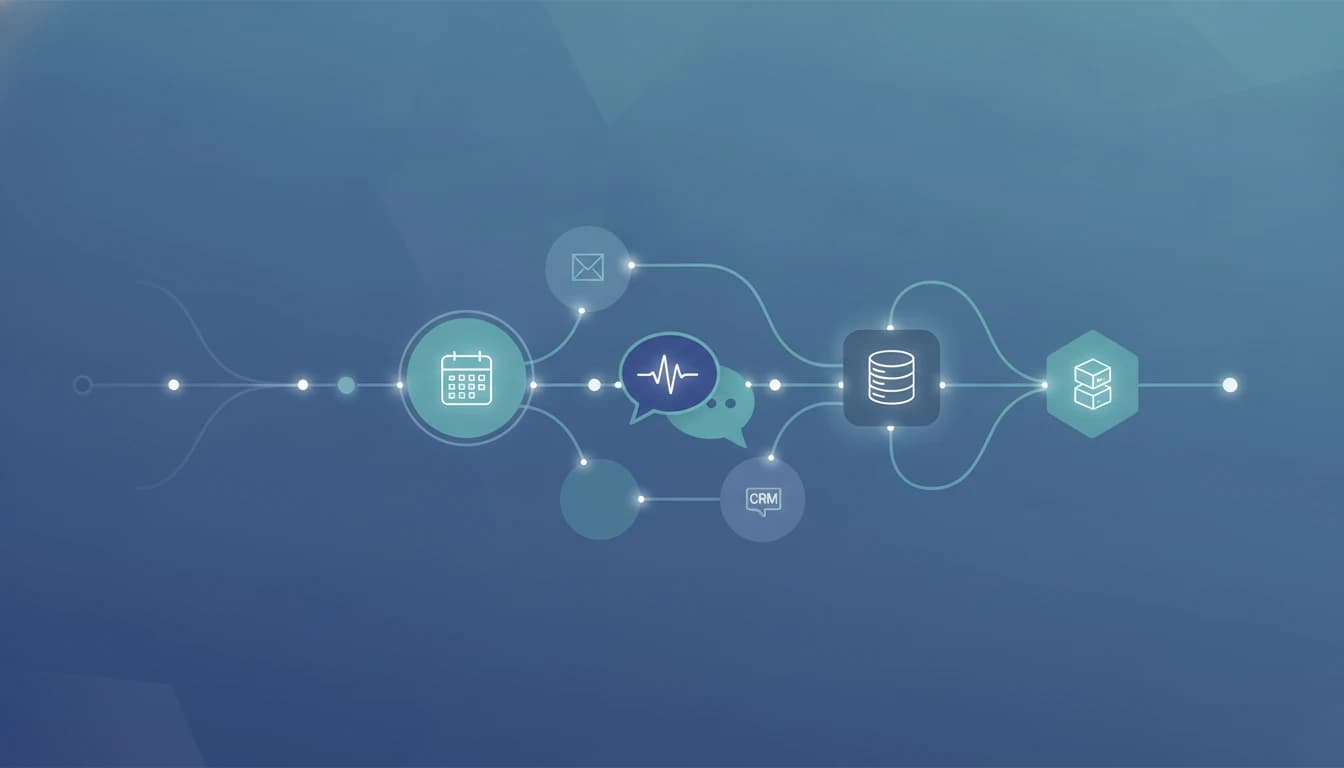
The conversation is maybe 20 percent of the work. The other 80 percent is the integration - the wiring that lets the assistant actually do the jobs above instead of just describing them.
When a customer asks "is the blue one in stock," the assistant is only useful if it can read your live inventory. When she says "book me Thursday afternoon," it needs write access to the real calendar, not a promise to "have someone confirm." When he asks "where is my order," it has to reach into your order system. Take that plumbing away and you are left with a very articulate box that cannot answer a single question that matters.
This is exactly the trap we wrote about for support tools in why the AI customer service agent tool you pick matters least: the model is a commodity, the integration is the whole game. Conversational AI is the same story wearing a different label.
Voice or chat: the channel decision most guides skip
Because both modes run on the same core capability, guides tend to lump them together. Operationally they are different projects.
Chat is cheaper to launch, easier to correct in flight, and forgiving - a customer will re-read a message. It fits businesses drowning in repetitive typed questions across web and email.
Voice is harder and higher stakes. It carries a speech-recognition and telephony layer, latency has to be near-instant or the call feels broken, and there is no scrollback for the caller to reread. But for any business where the phone is the front door - clinics, home services, real estate, dealerships - voice is where the leaked revenue actually lives, because missed and after-hours calls never leave a trace. Our complete guide to voice AI agents goes deep on that build, and if you are comparing the underlying platforms, Retell vs Vapi vs Bland breaks down the trade-offs.
The decision rule is not "which is better." It is "where are you bleeding." Start there.
Where it pays back
The payback math is not complicated, but it has to be your math. Here is an illustrative example, not a benchmark.
Say a small business misses or drops 40 inbound inquiries a month because they arrive after hours or when the team is slammed. Suppose, as an illustration, that 1 in 8 of those would have converted, at an average value of 500 dollars. That is 5 lost customers a month, or roughly 2,500 dollars in monthly revenue walking to whoever answered first. Against a conversational AI setup costing a few hundred dollars a month plus a one-time integration, the assistant does not have to be brilliant to pay for itself. It just has to answer.
Run the version of that with your real numbers - your inquiry volume, your close rate, your average deal - before you sign anything. If the recovered revenue does not clear the total cost inside a year, the project is not ready, no matter how good the demo felt.
McKinsey's finding that about 45 percent of the activities people are paid to do can be automated with existing technology is the tailwind here. A large share of your customer-facing busywork is, in principle, automatable today. The constraint is not the technology. It is picking the right conversation to hand over first and wiring it in properly.
How to actually deploy it without stalling
The projects that succeed follow roughly the same path:
- Pick one job, one channel. Not "customer experience." One concrete job - "book consultations from the website" or "answer after-hours calls" - on one channel. Scope creep is how these die.
- Map the systems it must touch. Calendar, CRM, inventory, knowledge base. If the assistant cannot reach them, it cannot do the job. This is your real spec.
- Write the handoff rules. Decide exactly when the assistant stops and a human takes over. A clean escalation path is what keeps customers trusting it.
- Wire, test against real messages, then launch narrow. Test with the ugly, real phrasing your customers actually use, not the tidy demo script.
- Measure deflection and conversion, not chat volume. The number that matters is jobs completed - appointments booked, tickets resolved - not messages exchanged.
Done in that order, conversational AI stops being a science project and becomes a piece of infrastructure that quietly earns its keep. That build - picking the job, wiring the systems, setting the handoffs - is the core of what our AI automation work delivers, and when the front door is the phone, our voice AI team handles the harder real-time side.
The one rule to deploy by
If you take a single line from this, make it this: never evaluate a conversational AI vendor on the conversation - evaluate it on what it connects to.
The talking is the commodity. Every serious tool answers the scripted question well. What separates the assistant that recovers that 7:15 Tuesday lead from the one that just apologizes politely is whether it can reach into your calendar, your CRM, and your systems and actually do the job. Buy the integration, not the demo, and conversational AI for business becomes the thing that answers when you cannot - instead of one more box that talks.