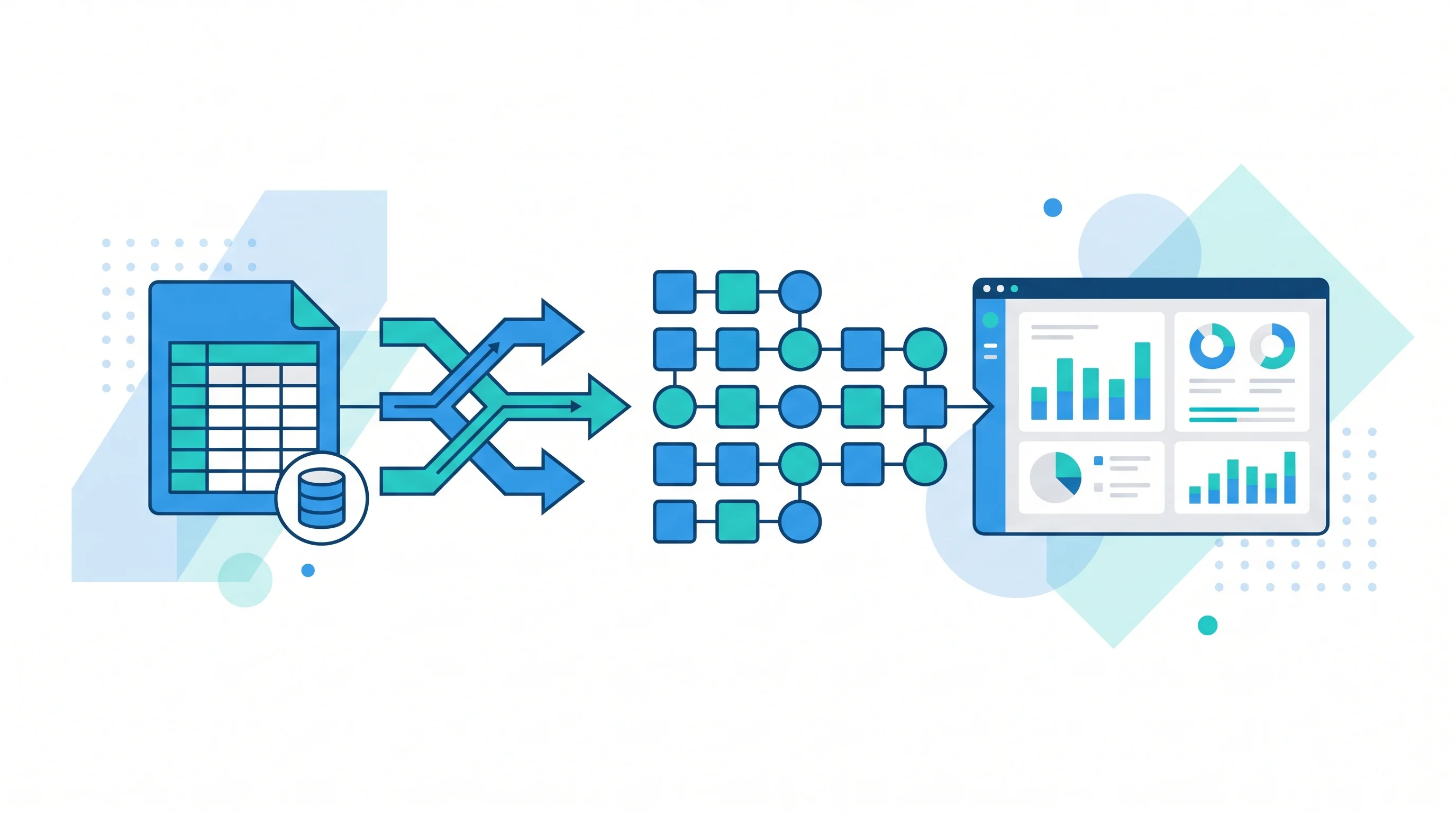

Most advice on data lake vs data warehouse starts from the wrong assumption: that you have to pick one. The comparison guides line up two columns, list the differences, and send you off to choose an architecture as if the choice were the point.
For the typical mid-market business, it is not. The honest answer is that you probably need a warehouse, you almost certainly do not need a lake yet, and the real risk is not picking wrong - it is buying expensive infrastructure to solve a problem you do not have.
That is the contrarian take, and this guide defends it. We will cover what each one actually is, the one question that decides which you need, why the lake gets oversold, and what to do when the answer is "neither, at least not yet."
What a data warehouse actually is
A data warehouse stores structured data in a fixed, predefined schema so it can be queried fast. You decide what the data means - customers, orders, revenue, sessions - before it goes in. That upfront work is called schema-on-write, and it is exactly why a warehouse is quick and reliable to report from.
This is the engine behind dashboards, KPIs, and recurring reports. When leadership asks "what was revenue by channel last quarter," a warehouse answers in seconds because the data was already cleaned, joined, and modeled on the way in.
As Amazon Web Services describes it, a data warehouse is optimized for structured data and business intelligence - the analytics that run your company day to day. Most of what a growing business needs from data lives here.
What a data lake actually is
A data lake stores raw data of any type in cheap object storage, in whatever shape it arrived. CSV exports, JSON payloads, images, log files, database snapshots - nothing is validated on the way in. You apply structure only when you read it, an approach called schema-on-read.
That flexibility is the whole appeal. As Google Cloud puts it, a data lake lets you store everything now and decide what to do with it later, which suits data science, machine learning, and workloads where you do not yet know the questions.
The trade is reliability and governance. A lake will happily accept anything, which means without discipline it becomes a place data goes to be forgotten - the "data swamp" that vendors warn about but rarely put in the sales deck.
The one question that decides it
Forget the feature tables for a moment. The decision comes down to one question:
Do you know what questions you need your data to answer?
If yes - and for most businesses running on a CRM, a billing system, and a few ad platforms, the answer is yes - you want a warehouse. The questions are known ("how many leads converted," "what is churn," "which campaign paid back"), the data is structured, and a warehouse serves those answers fast and cleanly.
If no - if you are collecting raw sensor data, training models, or storing unstructured content whose future use you cannot yet name - a lake starts to make sense, because its job is to keep options open.
The mistake is buying a lake for "flexibility" when your actual need is a dozen reliable reports. Flexibility you never use is just cost and maintenance wearing an aspirational label.
Why the data lake gets oversold
Data lakes get pitched to companies that do not need them for three reasons, and it helps to name them.
First, the word "big data" is sticky. A business generating a few million rows a month hears "lake" and assumes scale requires it. It does not. A modern warehouse like Google BigQuery or Snowflake handles very large structured datasets comfortably.
Second, lakes look cheap per gigabyte. Object storage genuinely is cheap. But storage is rarely the real cost - the engineering to keep a lake usable, governed, and query-ready is where the money goes, and that line item does not show up in the "storage is pennies" pitch.
Third, machine learning is fashionable. Teams provision a lake because they might do ML someday. "Someday" workloads do not justify infrastructure you maintain today. When the real ML need arrives, you will provision for the actual shape of it.
The lakehouse: real, but not for everyone
You will hear a third term, and it deserves an honest mention. A data lakehouse combines the cheap, flexible storage of a lake with the schema enforcement and fast SQL of a warehouse in one platform. Databricks, which coined the term, positions it as a single system for both BI and machine learning.
The lakehouse is a genuine advance for teams that truly have both needs - structured reporting and raw or ML data - and want to stop maintaining two stacks. That is a real category of company.
It is not most companies. If your entire data need is dashboards and KPIs, a lakehouse is a more complex answer to a question a warehouse already solves. Adopt it when you have the second workload, not because the architecture diagrams look impressive.
What this means in practice
Here is the sequence that keeps most businesses out of trouble.
- Start with a warehouse. It answers the reporting questions you have today and works natively with the structured data from your CRM, billing, and ad platforms.
- Get the pipelines right first. The value is not the store, it is clean data landing in it reliably. Our guide to the best ETL tools in 2026 covers how to move data in without hand-exports.
- Build the reports people actually use. A warehouse with no dashboard on top is a cost center. See data dashboard examples for what "actually used" looks like.
- Add lake storage only when a specific workload demands it. Large log files, raw event streams, or a real ML project - a named need, not a hypothetical one.
Notice that only the last step involves a lake, and it is conditional. For a large share of mid-market businesses, that step never arrives, and that is not a gap - it is a sign the warehouse was the right call.
The harder part is rarely choosing the box. It is getting trustworthy data into it and keeping it there without a person babysitting exports every Monday. That plumbing - the connectors, the transforms, the scheduled refreshes - is exactly what our data analytics and reporting service sets up, and it is why the pipelines that feed it are built as part of your broader workflow automation stack rather than as a one-off script.
If you want a second opinion before you commit budget, our take on when to bring in data analytics consulting walks through how to scope this without over-buying.
Key takeaways
- The data lake vs data warehouse choice is not usually an either/or. For most businesses it is a sequence: warehouse first, lake later if ever.
- The deciding question is whether you know what questions your data must answer. Known questions and structured data point to a warehouse. Unknown future uses and raw data point to a lake.
- The lake is the most oversold option. "Big data," cheap storage, and future ML get used to justify infrastructure a warehouse would cover at lower complexity.
- The lakehouse is real but conditional. It pays off when you genuinely have both structured reporting and raw or ML workloads - not when you only need dashboards.
- The hard part is the pipelines, not the box. Clean data landing reliably is what makes any of these architectures worth the spend.
If you are staring at a vendor proposal that leads with a data lake, hold it against the one question above before you sign. When you would rather have someone map your actual reporting needs to the simplest architecture that serves them - and build the pipelines that keep it fed - that is the exact engagement our analytics team scopes.